


Home Blog Page 2

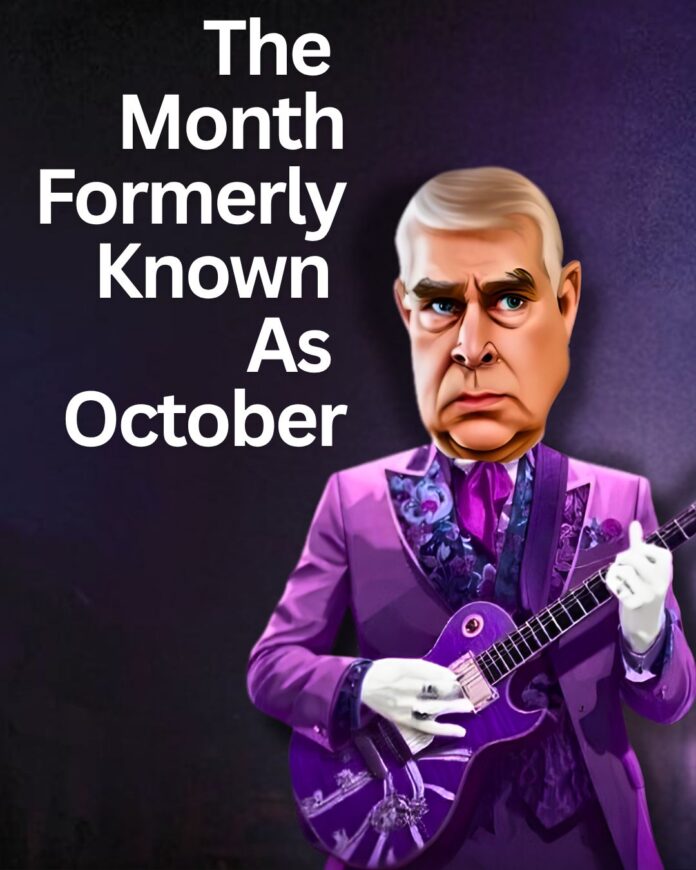
The month formerly known as October

8 NOVEMBER 2025 | OPINION

The Month That Defies Words

From grooming gangs betrayal to sectarian fear and royal disgrace, governance became improv.

It would be easy to call October a car crash, but that sounds too tidy. This wasn’t impact and silence. It sprawled across the calendar like a bad dream you couldn’t wake from. Each headline tested how far reality could bend before it snapped. I keep waiting for the Truman Show reveal, cameras, a director, someone shouting “cut!”, but it never comes. And if you think it can’t get worse, it does.

Start with Hadush Kebatu. An Ethiopian national who arrived by small boat in June, sexually assaulted a 14-year-old girl and another woman within days. Convicted, sentenced, and due for deportation until 24 October, when he was wrongly released. He wandered, boarded a train, sparked a two-day manhunt, and then came the punchline: the government paid him £500 to leave quietly. A convicted sex offender rewarded to go away. If this is border control, the border is a revolving door with a tip jar.

And while ministers patted themselves on the back for “tough” immigration policies, the grooming gangs inquiry collapsed under the weight of its own hypocrisy. Survivors walked out. Jess Phillips didn’t just fail in her role; she failed the country. Her resignation was inevitable, but not enough. She should have left Parliament. This wasn’t a blunder; it was a stain on the nation’s soul. Add the “one-in, one-out” migrant return boomerang and the pattern appears: chaos dressed up as control, accountability reduced to theatre. You want standards? So do I. Keep looking.


When Failure Turns Toxic

Then came the streets, the new frontline of collapse. Football turned into a proxy war. The Maccabi Tel Aviv row at Villa Park wasn’t about safety or “community concern”. The moment those same voices chanted “from the river to the sea” on Oxford Street, parroting Hamas, they forfeited moral outrage. This isn’t solidarity; it’s new hate. You know it. I know it. Own it.

West Midlands Police’s failure to protect Jewish fans was a national disgrace, proof Britain can no longer guarantee safety in public spaces. That isn’t policing; that’s abdication. A fear now hangs in the air – the kind you can’t disinfect with a press release.

As if October hadn’t already hit rock bottom, the Manchester synagogue attack showed us what pure evil still looks like. An act so stark it left silence in its wake – the kind that chills because it feels like history clawing back through the floorboards.

Days later, the streets filled again. Pro-Palestine rallies thundered through the cities. Some marched for peace; others for something darker. “From the river to the sea” is not coexistence; it is a threat. When that chant echoes down Oxford Street, the moral high ground collapses.

Even symbols weren’t safe. The Barnsley poppy lamppost row turned remembrance into a flashpoint – proof that even decency can be weaponised when identity politics runs riot. A town arguing over poppies in the same month as a synagogue attack; if that doesn’t tell you how fractured we’ve become, nothing will.


Collapse In High Places

While the streets burned, the palaces trembled. Prince Andrew’s titles and privileges were stripped, a graceless humiliation for a monarchy desperate to cauterise its wounds. Don’t mistake it for redemption; it was damage control, not consequence.

Elsewhere, the China spy case collapse and the Kneecap terror trial failure exposed a state that talks tough, but can’t hold its own line. Abroad, the Israel–Gaza ceasefire framework flickered into life; fragile, and overshadowed by our own noise. Even the Nobel Peace Prize became a circus, with the “Trump snub” offered as global pantomime.

And because October wasn’t done mocking us, the Louvre jewel heist gave a touch of cinematic absurdity, while budget warnings whispered of storms ahead. Rachel Reeves’ rental licence row proved that housing policy can descend into farce when ambition collides with reality. Add the Soldier F acquittal and the Caerphilly by-election, and what you have isn’t governance, it’s improv with props.


The Curtain Call

So there it is. A month that didn’t just bend standards; it shattered them. Governance became theatre, accountability a rumour, and public life a stage for chaos. Still waiting for that Truman Show reveal? Me too. But don’t hold your breath.

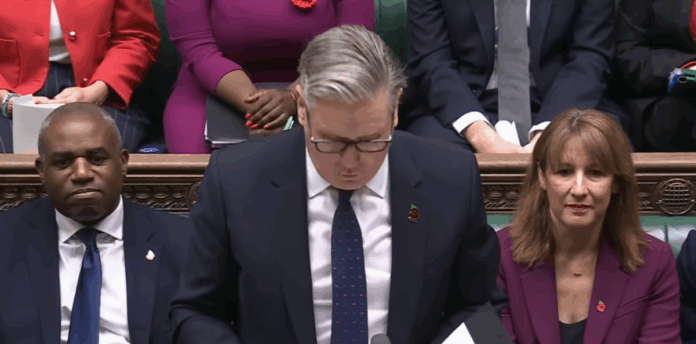
Not so Lammentable? – PMQs 5th November 2025

Credit: UK Parliament / YouTube
5 NOVEMBER 2025 | OPINION

The commentariat are lammbasting Deputy PM David Lammy for his allegedly calammitous performance at PMQs. However, they need to look more closely at James Cartlidge’s daft questioning.

JC told Lammy he was surprised that the DPM had not apologised to the victim’s family for the accidental release from prison of the Ethiopian sex offender. Lammy replied that he had then and repeated it now. Cartlidge continued obliviously with “I do think the Deputy Prime Minister owes it to the family to offer an apology here on the Floor of the House”, and when the reaction made his error clear, he had to cover with “he should have done it at the start of his remarks”.

JC said these were “very serious matters” that required him to ask a “further, very important question”:

“Can he reassure the House that since Kebatu was released, no other asylum-seeking offender has been accidentally let out of prison?”

Everybody (including Lammy, as he later admitted) knew the answer to that already. It was in the morning edition of the The Daily Telegraph: there had indeed been another inadvertent release of a foreign jailbird, an Algerian this time.

The DPM dodged the query and counter-attacked – this is exactly what Starmer has often done, with Mrs Badenoch telling him and us that she has noticed. Lammy said JC had been Justice Minister himself while prisons were rotting; early releases began under the Tories in 2021; Labour was now busy fixing the mess; Dame Lynne Owens was continuing her investigation. All fair points.

We could have moved on, but no, JC was channelling his inner Paxman. He continued to over-emphasise, saying these were “extremely serious crimes” and therefore felt he had to repeat the “very specific” question. By George, he was going to nail the DPM!

Lammy replied with what he had done and was going to do to sort the problem. His tactical error lay in not admitting blandly that there had been another inadvertent release and then making all his valid points, spinning it as a legacy Conservative failure. But it may not have been his error; doesn’t the Cabinet Office script everything?

On JC’s side, what did he hope to achieve with his repetitions? We all knew the news and the Tories could expect no response but reminders of their own incompetence.

Cartlidge’s persistence was getting annoying, and when he lectured Lammy on his duties as Justice Secretary, the DPM exploded: “Get a grip, man! I know I am the Justice Secretary.” The bully-ragging had provoked the powerfully-built man into bovine aggression, leaning over the Despatch Box, jabbing his finger and shouting. There is a reason why the centre aisle is thirteen feet wide.

Was that Cartlidge’s aim, to show that Lammy’s short fuse makes him an inappropriate candidate for the top job when Starmer quits? There is to date no indication that Lammy wants it; but if the choice is between him and the boggle-eyed eco-zealot who is destroying our industrial economy, then hooray for Britain’s first black PM! At least he is sane.

JC started again: “The purpose of government is to take –” responsibility, we assume, but his pomposity was interrupted by noise from the benches.

In the end, Cartlidge never got to his killer punchline, for he had miscounted his allocation of questions and the Speaker guillotined him. JC was reduced to a post-session afterthought in the form of a Point Of Order, about whether Lammy had known of the Algerian incident. Hoyle wafted him away with: “You have put it on the record.”

A further afterthought came into the media from some spinmeister who pointed out that Brahim Kaddour Cherif is not, in fact, an asylum-seeker, but a visa over-stayer.

The Leader of the Opposition’s position is in no immediate danger.

Was this whole to-do about prisons, or about the relentless rubber-boat invasion? If the latter, a better case might have been the man who came back here a month after being thrown out of the country – perhaps collecting frequent-floater points?

Meanwhile, our frequent-flyer PM was in Brazil for the COP30 international climate conference, along with Prince William, Energy Secretary Ed Miliband, the Mayor of London Sir Sadiq Khan, the metro-mayor of West Yorkshire Tracy Brabin, and a host of British assistants and advisers.

Eight miles of Amazonian rainforest had been bulldozed to create a four-lane highway to Belém for 50,000 aviation-borne global eco-champions. Absentees from this fossil fuel-burning beano included major polluters India, Russia, the US and China. Irony is not dead: blame it on Rio.

Back in Westminster, Lib Dem Deputy Leader Daisy Cooper spoke of threats posed by Russia, China and Elon Musk. Her supplementary was about taxing banks rather than “struggling families”, in response to which the DPM “gently” reminded her of her Party’s role in Coalition-era austerity.

The SNP’s Stephen Flynn tried to link BBC’s Scam Safe Week to the upcoming Budget, and was treated to the usual lecture on the SNP’s failures. Lammy later assured the Scots that they were not a threat to national security, but that the SNP, with its opposition to the nuclear deterrent, was.

Other questions and comments included:

  • The multiple stabbing on a train in Huntingdon, and heroic civilian defenders there;
  • The murder of mothers by their children;
  • Crowdfunding for a young cancer patient;
  • Seeking NHS drug approval for a rare mobility disorder;
  • Prostate cancer research;
  • The alleged failures of Reform UK in Kent;
  • Contrasting the National Minimum Wage with the non-Parliamentary earnings of Reform UK leader Nigel Farage;
  • The threatened closure of the Lindsey oil refinery;
  • As Remembrance Sunday approached, commemorating the wartime military contribution of Jews and the West Indies Regiment, and Indian troops, for whom a marigold may also be worn;
  • Funding for the London Metropolitan Police;
  • Housing for the Armed Forces;
  • Leaseholder rights;
  • Engaging young people in politics;
  • The need to limit the burning of waste;
  • Coordinating repair works to road rail and utilities;
  • Access to NHS dentistry;
  • Review of maternity and neonatal services;
  • The hurricane damage in Jamaica, and the need to combat climate change.

… all so much more important than making teacher lose his temper!

PODCAST: Down the Pub #6

Along with Peter Simpson and Szymon Sawicki, we discuss the latest scandals among the Front Bench, as well as a new Deputy Leader for the governing party, and some fresh elections in the Netherlands too.

Catch up on what we had to say below!

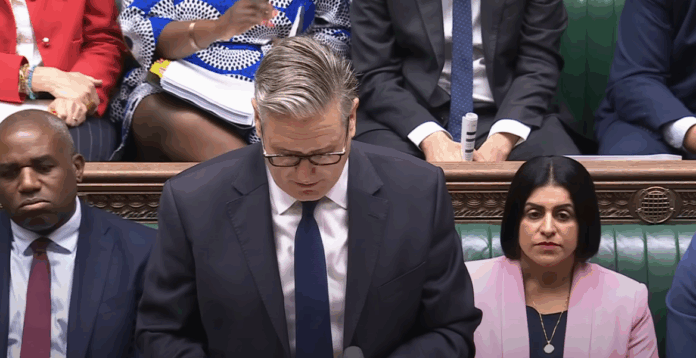
Gollum and Golem: PMQs 29th October 2025

Credit: UK Parliament / YouTube
29 OCTOBER 2025 | OPINION

Recently, the Speaker has allowed Sir Keir some latitude in his opening preambles. On the 15th, Starmer included 450 self-justifying words on the China spy case; this week, he slapped the Tories and Reform over the new Renters’ Rights Act, and both parties (Reform here dubbed “Putin-friendly”), plus the Greens, over NATO. Who is supposed to be replying to whom? Perhaps these sessions should be be retitled Prime Minister’s ‘Provocative Assertions…’

… and ‘Bendy Answers’. Labour’s Nick Smith opened with a question on nuisance off-road biking in Wales, so that the PM could boast of extra police numbers and powers. But Starmer did not stop there – he noted that the Tories and Reform had voted against the Crime and Policing Bill last June, without mentioning their reasons, which included concerns over further potential restrictions on protests and free speech.

Enter the Dragon.

Mrs Badenoch repeated verbatim a question she put on 9 July based on Labour’s election Manifesto: “Labour promised not to increase income tax, not to increase National Insurance and not to increase VAT. Does the Prime Minister still stand by his promises?”

Sir Keir’s response then had been a straight “yes”; today, it was 87 words longer, with none of it to the point. “Well, well, well; what a fascinating answer,” remarked LOTO. The PM countered that “no Prime Minister or Chancellor will ever set out their plans in advance”, although he had done exactly that in July and the Chancellor was now “flying kites” (as KB put it) about tax rises in the coming Budget.

There followed some unenlightening exchanges on how the nation’s finances had been handled under the Conservatives, culminating in Starmer’s statement that “the Conservatives were kicked out of office because they broke the economy” – an elephant in the room threatened to trumpet at that contention. As for what according to Sir Keir are the Government’s current successes… “events, dear boy, events,” said Supermac.

LOTO threw in a suggestion of her own, one that brightened the Conservative Party conference three weeks ago: scrap Stamp Duty on family homes. She may need to rethink that wheeze. It is always nice to be let off an impost, but quite possibly the effect would be nullified by a corresponding rise in house prices. The driver for socially destructive asset inflation is the willingness of banks and building societies to lend money – especially during manias like the one that led to the 2008 Global Financial Crisis, or the “Barber Boom” of the early 1970s. There must be some way to rein in such expansion of credit if another great disaster is to be avoided. Can anyone come up with a workable scheme?

There followed an uncomfortable question from Labour’s Jeff Smith, on Gaza, IDF airstrikes and withheld aid, skirting around Hamas’ own breaches of “the peace agreement and international law”. The PM registered his concern.

In came the Leader of the Lib Dems, who as before wanted to smear Reform with “Russian meddling and money”. Starmer gladly joined in, using his scriptwriters’ buzz-phrase “Putin-friendly” twice more.

“Comparisons are odious”: at least the Russian President was directly elected last year, and with 88 per cent of votes cast. Here, we have a lumbering golem of a PM no longer desired by the people and continuing the destructive constitutional programme initiated nearly thirty years ago by a power-obsessed Gollum. Who is more of a threat to democracy?

Sir Ed returned to another pet topic, the alleged “damage of Brexit”. He reminds me of C. Northcote Parkinson’s board member who is valued because he is consistently wrong. The PM was happy to concur with his “opposition” about “the botched deal of the last Government and the damage that has done to our economy”. Of the damage done by 46 years of our EEC/EU membership, he had nothing to say.

Other questions touched on health services, special needs, football, knife crime, the state pension ‘triple lock’ and frozen personal tax allowances, the loss of bank branches, the “disarray” at the Home Office, the difficulties faced by small businesses, the opportunities for R&D offered by Cambridge University, and the King’s praying with the Pope in the Sistine Chapel.

Labour’s Annaliese Midgley deplored Reform’s opposition to the Employment Rights Bill, but failed to reflect on the ERB’s unintended effect on employment levels.

As the government presses on with its digital ID scheme, it was useful to hear from the DUP’s Gavin Robinson about a massive data breach in Northern Ireland, in which all PSNI police officers had their personal details leaked, which “represented not only a breach of privacy, but also an increased risk to their safety and that of their families”. He told Sir Keir that the Treasury was balking at releasing financial reserves to deal with it; the PM replied with a boilerplate response on how much HMG has already provided to the PSNI and the Northern Ireland Executive, and handed off this issue to the latter.

Also relevant to the theme of potential electronic disaster, the Lib Dems’ Caroline Voaden bemoaned the imminent closure of the last bank in the Devon town of Totnes and asked for a “banking hub”. Without that, readers may fear we shall be driven to a plastic card/smartphone-operated (and ‘tyranny-friendly’) central bank digital currency. Anyone who has watched shoppers fiddle with their devices at supermarket checkouts as the line lengthens will have a glimpse of the future.

Perhaps it is time to revive local currencies instead, like the ‘Totnes Pound‘; a scheme in the Austrian town of Wörgl during the depths of the Depression was such a boost to its economy that the central bank quickly banned it.

“Freedom is frightening”, especially for the Powers That Be.

PODCAST: Down the Pub #5

Along with Peter Simpson, we discuss the upcoming Caerphilly by-election result, how the ‘Uniparty’ is having leadership problems, and splits going on with the far-left.

Watch below to hear more about that!

PODCAST: Down the Pub #4

In this fourth episode with Peter Simpson and Szymon Sawicki, we largely talk about the Chinese spying case, how British national security works, and how activism can be used effectively… or not so much.

Watch below to hear more about that!

The Manchurian Candidate? – PMQs 15th October 2025

Credit: UK Parliament / YouTube
15 OCTOBER 2025 | OPINION

How much longer can this Prime Minister continue in office?

In the first place, his policies appear chaotic. He has said he wants to help ‘working people’ – defined by him as those who do not have savings – yet the public sector employees who have been awarded pay rises also tend to have generous final salary pension schemes, a gold-plated form of savings for old age increasingly unavailable to those in the private sector. Also, the pensioners who were to be hit worst by the withdrawal of the Winter Fuel Allowance are retired workers on a low income and with little or no savings.

He wishes to ‘fix the foundations’, yet the main burden of NIC increases has fallen on the private sector since the Government gave extra funds to the public sector to compensate for the tax. Was it not foreseeable that employment in the former group would stall, together with the economy as a whole?

And then there is Chagos. How could it possibly benefit this country to give away a territory and then pay many billions to rent it back? Especially one that sits at a key point in the Indian Ocean, like a queen in the centre of the chessboard? It is all very well saying that our use of the islands is secured into the next century, but so was Hong Kong in 1898 and the lease on that ended too.

I had begun to wonder whether Starmer simply intends to destroy the nation, deluded by some Marxist fantasy that something better will replace it – as the anarchist Bakunin said, “the urge to destroy is also a creative urge”. World government sounds like a wonderful idea, until you see the white cat-strokers and crocodile-faced billionaires who would love to run it.

Perhaps the truth is more tawdry. If the Mail’s Dan Hodges is right, we are near broke, so Starmer is going round the world with his “Union Jack-embossed begging bowl”; he needs to do China’s bidding to help keep our finances afloat. It is not he who is in charge, says Hodges, but the “48 Group” (est. 1954) of British traders with China.

Connect the dots: a new giant Chinese embassy allowed to be constructed in the heart of London, complete with – allegedly – an underground dungeon; the surrender of a key military asset in the Indian Ocean; and now the collapse of a China-related spy trial because our security adviser – sorry, just his deputy Matthew Collins, nobody else was involved, it is claimed – was unwilling to say that China, which has been stealing our secrets for years, is a potential threat.

We weren’t even going to have sight of what the adviser said, but thanks to press pressure we now are; though we will possibly not see what the adviser was advised, and by whom.

And now Hodges is saying Sir Keir is an outright liar on the matter. When the Leader of the Opposition challenged him to say that Collins had not discussed the subject with the Home Secretary or anyone in Downing Street, the PM said that was so.

At the end of PMQs this week, according to parliamentary sketchwriter Quentin Letts, Conservative MPs “shouted ‘False! False!’ at his retreating heels”. This does not appear in Hansard’s record, but Letts was there.

Another reason for those shouts at him may have been the concluding point of order raised by Sir James Cleverly (Con) who said that he had been misquoted by Starmer in this session (and earlier this week by the Security Minister) as stating that describing China as a threat was merely “unwise”. In fact, he had said that to sum up our position in one word was unwise, but had gone on to say: “First, we will strengthen our national security protections wherever Beijing’s actions pose a threat to our people or our prosperity… and when there are tensions with other objectives, we will always put our national security first.”

The Speaker noted that Cleverly had now put it on record and “I will leave it at that”. But he also allowed (“do not question my judgment”) the PM to make a preliminary statement about Chinagate before answering any questions.

Another bit of backtracking before verbal combat commenced was the PM’s reference to the fourth anniversary of Sir David Amess’ murder and that of Jo Cox. He took “this opportunity to condemn unequivocally the death threats made against the Hon. Member for Clacton [Nigel Farage]”. Doubtless, that put him back on the side of the angels after Labour’s recent concerted attacks focusing on Reform’s Leader, so Zia Yusuf need not hold Starmer responsible should there be a Charlie Kirk-type incident.

If Sir Keir had hoped his opening China spy trial peroration would take the wind out of Badenoch’s sails, he was mistaken, though she was seen to cross out some sentences from her script during his speech. His responses to her vigorous questioning were a farrago of blame-shifting, misquotation and (allegedly) lies, topped off with woolly aspirational distraction.

The last cornily patterned soundbite was likely crafted by one of his assistant wordsmiths: “Labour is building a better future; the Conservatives cannot even come to terms with their past”. I make no space here for his guff-fest, but leave it to readers to boil what he said down to something relevant and fully truthful, if that is at all possible.

Instead, let us make room for some other participants.

  1. Tom Rutland (Lab) offered the PM the chance to talk about Labour’s plans for apprenticeships.
  2. Baggy Shanker (Lab) ditto, on knife crime in Derby.
  3. Daisy Cooper (Lib Dem deputy leader) sought assurances that Hong Kong immigrants to the UK would be protected from Chinese persecution; she was not quite comforted by the PM’s reply. She also deplored Elon Musk’s legal expenses assistance to the “far-right, racist hate-preacher Tommy Robinson”; Starmer declined to comment as the trial was ongoing.
  4. Alex McIntyre (Lab) called on the PM to commemorate next year the last stand of the “glorious Glosters” in Korea in 1951, preventing the capture of Seoul. Starmer referred this to the attention of Defence Ministers and noted Labour’s commitments to veterans.
  5. Liz Saville Roberts (Plaid Cymru) twitted Sir Keir over his reluctance to appear in the Caerphilly by-election next week, where local support for Labour was collapsing; the PM riposted with what money the Government had given Wales and how much independence would cost the principality.
  6. Lloyd Hatton (Lab) asked for a new special school in Portland, Dorset and was referred to the Schools Minister for an update.
  7. Sir Julian Smith (Con) re-raised the issues of family farms, inheritance tax and national food security. He was treated to the familiar boilerplate on farming policies, the devils of which are in the details not touched on here.
  8. Ben Goldsborough (Lab) urged the compulsory testing (“Zoe’s law”) of all skin moles for cancer, from which he himself was now suffering.
  9. Peter Bedford (Con) asked whether the PM would consider scrapping stamp duty on residential property, as LOTO was promising (or at least commit to no rise in property taxes). Sir Keir said that would mean unfunded tax cuts, and more austerity for public services.
  10. Sam Rushworth (Lab) called for a public enquiry into suicides among mental health patients in her area and the failings of its NHS mental health trusts. Starmer said the Health Secretary was “currently considering the best way forward”.
  11. Rebecca Smith (Con) said she was launching a small business survey among “small and medium-sized enterprises” (SMEs) in her constituency, in the hope of abolishing or limiting business rates and taxes; the PM said he would supply her with Labour’s small business strategy, so she could give some copies to them.
  12. Jim Dickson (Lab) asked the PM to agree that Labour were addressing the need to repair transport infrastructure; he did.
  13. Tom Gordon (Lib Dem) called for the provision of local mental health in-patient beds in his constituency; Starmer spoke of related nationwide NHS recruitment, hospital building and increases in mental health spending.
  14. Kirith Entwistle (Lab), a “second-generation immigrant”, reminded the PM of his Conference words on the need for national unity and asked him to agree that “some of those on the Opposition benches who seek to stoke division and keep close company with those who accept Russian bribes cannot and should not be trusted to govern this country?” Ignoring the Russiagate theme, Starmer noted it was National Hate Crime Awareness Week and “an attack on one of us is an attack on all of us”.
  15. Susan Murray (Lib Dem) spoke of the financial burdens the Government laid upon, for example, a beauty salon. The PM replied with points about lower rates for some types of small business, stimulus for lenders to them, and a package on support for late payments.
  16. John Whitby (Lab) returned to the Russian bribe theme re Labour’s coming Elections Bill “to protect our democracy from foreign interference” (China was, however, not mentioned). Starmer was happy to tar Reform UK’s Farage and Tice with guilt by association with their party’s former regional leader in Wales (who had taken Russian money in 2018/19 while a UKIP/Brexit Party MEP). The PM said that Britain’s choice was “Kremlin cronies sowing division or Labour patriots working for national renewal”. Farage was not invited to respond and later fumed. Starmer thus reaffirmed his patriotism, but neglected this opportunity to do the same for his Christianity, as he did last month (“I was christened, so that is my church, has been all my life”). A pity – surely he is at least as pious and proud of his fatherland as a Welsh choirboy?
  17. Tom Tugendhat (Con) reverted to the China spy trial and asked: “What political direction did this Government give to their officials before they went to give evidence?” Thus came the answer: “Absolutely none – absolutely none.”

And so, aside from Sir James Cleverly’s point of order, that was that. Exit the PM, pursued by Conservative catcalls.

PODCAST: Down the Pub #3

In this third episode with Peter Simpson and Szymon Sawicki, we mainly discuss political factionalism and the Tory Party Conference.

Watch below to hear more about that!

September 2025: The month the dystopias came true

Credit: batub95 / DeviantArt
6 OCTOBER 2025 | OPINION

Orwell warned of surveillance, Huxley of control through comfort, Kafka of faceless justice, Bradbury of thought turned into crime. In September 2025, Britain proved the warnings weren’t ignored – they were welcomed.

1984 was meant as a warning, not a guide – but this September, our leaders assembled a flat-pack dystopia with terrifying ease.

The past month showed that Britain’s dystopia is not creeping in at the edges – it is being built in plain sight. For decades, politicians had controlled the public through language, branding every critic ‘far-right’ and every objection immoral. But the spell broke. People stopped believing it. And so September became the month our leaders abandoned persuasion and reached instead for technology, secrecy, and fear.

The ‘BritCard’ digital ID captured it perfectly. Sold to the public as a tool of convenience – one card to access healthcare, benefits, banking, even travel – it was presented as efficiency. In reality, it was a leash. Not promised in Labour’s Manifesto, not debated in Parliament, simply imposed. This wasn’t about streamlining services; it was about obedience. Once, governments tried to control language. Now, having lost that battle, they have moved on to controlling access to daily life itself. Orwell’s telescreen no longer sits on your wall – it lives in your pocket.

This instinct to hide and to flee defined Labour’s month. Angela Rayner fell over her hypocrisy on stamp duty. David Lammy’s promotion doubled down on foolishness. Morgan McSweeney’s scandals dragged on, Lord Mandelson was finally jettisoned as US Ambassador, and Downing Street’s PR collapse left ministers blaming their own messengers.

Bridget Phillipson dangled a policy U-turn on the two-child cap, while angling for the deputy leadership, aided by the quiet readmission of John McDonnell and other rebels who had once lost the whip over the same issue. And through it all, Rachel Reeves clung to Number 11 not on competence but because the markets feared the next incompetent buffoon. Burnham and Khan, meanwhile, edged closer together – circling like vultures above a leadership that looks weaker by the day.

That cowardice created the space where the outsiders grew. Reform UK surged in the polls, fuelled not only by Labour’s implosion but by the migration crisis itself. September saw the first deportations under the new Franco-British scheme, hailed by Starmer and Foreign Secretary Yvette Cooper as a breakthrough. In truth, it was nothing more than the “pass the migrant” farce — the policy equivalent of a strongly worded letter in the face of a never-ending invasion.

And Reform’s contradictions deepened: welcoming failed Conservatives like Nadine Dorries and Jake Berry, to the disgust of its own members. The same mood spilled into the streets with Unite the Kingdom rallies, Tommy Robinson on the march, and the absurd Raise the Colours bunting rows that tied councils in knots. Across Europe, the AfD surged in Germany, proving this was not uniquely British. Huxley warned that once the narcotic of comfort wore off, anger would follow. September proved him right.

The wider world only underlined the point. In America, Turning Point founder Charlie Kirk was assassinated; a conservative voice silenced in an act of raw political violence. A week later, Lucy Connolly walked free, with her release weaponised by Trump to humiliate Starmer.

And then came appeasement on the grandest scale. Britain recognised the state of Palestine, hailed by Hamas as “the fruits of October 7th”. In one stroke, Westminster legitimised those who slaughtered civilians. The House of Commons didn’t just look weak; it looked complicit. Collaborators in terror – not whispered in the shadows, but shouted proudly from the despatch box.

The insult deepened when Gaza was handed to Sir Tony Blair as though it were a protectorate. The same Blair who helped ignite the very instability now consuming the region. It was a colonial throwback disguised as diplomacy, outsourcing responsibility so Ministers could pretend they’d acted while washing their hands of the consequences.

The world’s institutions only deepened the cynicism. Genocide scholars declared Israel guilty, and the UN General Assembly voted for a ceasefire. Starmer’s recognition of Palestine, instead of steadying Britain’s place on the world stage, tied us to appeasement just as the international system recast Israel as the villain. What was marketed as peace was, in truth, surrender – proof that Britain no longer shapes events, but bends to them.

And while Britain appeased, real leaders redrew maps. Trump met Putin in Alaska: nothing agreed, but everything implied. Putin stood as an equal to the leader of the free world, smiling for the cameras. It was his victory and Trump’s humiliation; the moment a tyrant achieved parity without firing a shot. Elsewhere, China rolled tanks through Beijing in its Victory Day parade, and the US clashed with Venezuela, as the Cold War script rebooted.

So September joined the dots. Surveillance at home, appeasement abroad, politicians paralysed, populists rising. It was not a list of isolated scandals – it was the shape of a new order. Orwell told us surveillance would be normalised. Huxley told us comfort would be used as control. Kafka told us justice would be faceless and absurd. Bradbury told us jokes could be treated as crimes. We were warned.

We laughed at them. Then we lived it.

The warnings weren’t ignored. They were welcomed.

PODCAST: Down the Pub #2

In this second episode with Peter Simpson and Szymon Sawicki, we discuss the Labour Conference – including various scandals and smears – as well as anticipating the upcoming Tory Conference.

Watch below to see what we talked about!

More from this author

Don't miss...

Wolves of Westminster