


Home Blog Page 65

Who can win the next General Election? – Tom Pritchard

19 August 2019 | OPINION

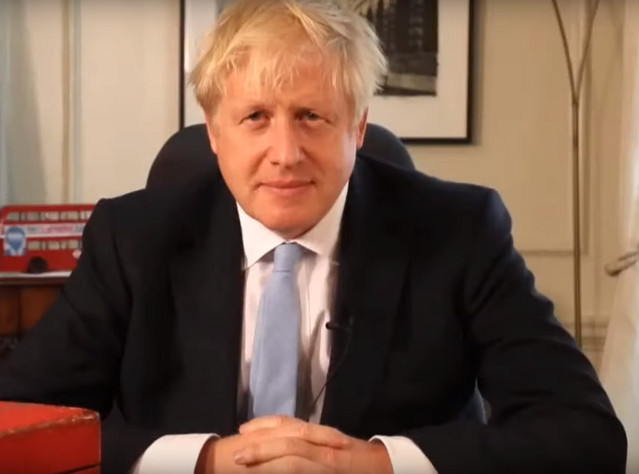
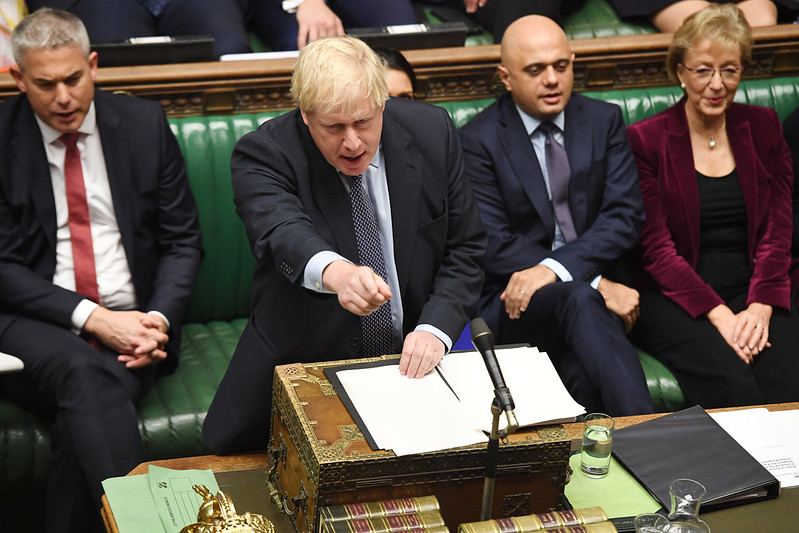
Thanks to Boris, the new Prime Minister, those who donate large amounts of money to the Conservative and Unionist Party are starting to do so again. This is essential if my party is to win the General Election, as well as the next set of Local Elections in the spring of next year.

Thanks to the new Prime Minister, many Conservative Associations have reported an increase in membership, whether that be members who had left for the Brexit Party or new members entirely.

It now looks a little more likely that the Conservative Party will win the next General Election that it did a few months ago, before Boris Johnson became Leader of the Party and Prime Minister.

In relation to foreign policy and the values that underpin that foreign policy, Prime Minister Boris Johnson and Labour Leader Jeremy Corbyn sit a country lightyear away from each other. Despite many believing Corbyn to be a secret Brexiteer, it is obvious that he is being forced by his party to be more pro-EU than he may perhaps wish to be. In addition, Corbyn is sadly very anti-America. It seems to many that Corbyn and a good deal of of his colleagues in the Labour Party are a radical leftists who appear to regret the outcome of the Cold War.

Despite this clearly unpopular and – as many would say – immoral foreign policy, Jeremy Corbyn’s Labour Party is still in with a chance of being the largest party after the next General Election. Despite his weak position on Brexit, which will not go down well in Labour heartland seats in Wales and the North of England, Jeremy Corbyn is very popular amongst many young people, especially in London and constituencies commutable to London in Surrey and West Kent.

On the other hand, Boris Johnson has repeatedly called for leaving the EU by October 31st, ‘come what may’, ‘do or die’. This goes down extraordinarily well with many in the Conservative Party and the Brexit Party, as well as any voters who voted to leave the European Union in 2016. Moreover, Boris was also elected twice as the Mayor of London and as a result many in London Conservative Associations such as Kensington and Chelsea feel optimistic about their chances of winning back their constituencies after they were lost to Labour in the 2017 General Election. It is clear that good old Boris has a proven track record of electoral success, having won two London Mayoral elections and being the winning face of the Brexit campaign.

In addition to this quiet optimism in respect of the Conservatives doing well electorally on the back of Brexit, other foreign policy matters could make or break Boris Johnson as Prime Minister. Whether this be taking a strong stance against Iran, intervening in Hong Kong in protest over the behaviour of the Chinese government and of pro-China parties in Hong Kong, or building a special and closer relationship with the Commonwealth and the United States.

As well as these complex issues that currently face the Foreign Office and Downing Street, Boris Johnson will also likely be entering the UK into a free trade deal with the US. This will be a brilliant act of unity between the two countries. It is important that the UK and US maintain a very special and intimate relationship so that we can trade more freely, work to combat international terrorism and climate change, bring about a solution to the problems with Iran and give more Anglo-American support to Israel.

All of this is especially important as Britain leaves the European Union, and all of these matters will determine whether or not Boris Johnson as Prime Minister and his administration have been successful in the realms of foreign policy. Ultimately, this will be the test for whether or not the Conservatives can win the next General Election.

Labour and Lib Dems at loggerheads amid “emergency government” row

16 August 2019 | UK NEWS

Labour Leader Jeremy Corbyn has publicly decried the stance adopted by the new Liberal Democrat Leader, Jo Swinson, after she continued to insist that Mr Corbyn was not the right man to lead the proposed ’emergency government’ proposed by the ‘Unite to Remain’ alliance of the Lib Dems, Greens and Plaid Cymru.

Speaking to Press Association reporters, Mr Corbyn said: “It’s not up to Jo Swinson to choose candidates; it’s not up to Jo Swinson to decide who the next prime minister is going to be.” He added: “Surely she must recognise she is a leader of one of the opposition parties who are apparently opposed to this Government, and apparently prepared to support a motion of no confidence.”

Ms Swinson had previously dismissed Mr Corbyn’s plan to bring down Boris Johnson’s Government with a Vote of No Confidence before installing himself as Prime Minister to lead a ‘caretaker government’ – presumably in a minority – whose function would be to block No Deal by requesting a further extension of Article 50 from the EU. Mr Corbyn has said that any such government should be “strictly time-limited”, and that his final action as interim Prime Minister would be to call a General Election in which Labour would campaign on a manifesto supporting a second referendum on EU membership, including an option to Remain.

Ms Swinson apparently took the view that Mr Corbyn would be too divisive a candidate to unite both rebel Conservatives and independent MPs, suggesting veteran Parliamentary figures such as Ken Clarke or Harriet Harman as alternatives. However, the Labour leadership appears to be unwilling to countenance any form of ’emergency government’ that is not led by the present Leader of the Opposition.

Mr Corbyn has said that the smaller parties should respect the “normal precedent” that the Leader of the Opposition should attempt to form a government if the incumbent administration falls in a confidence vote. He also suggested that opposition politicians should consider supporting his proposals, instead of “making a noise in the media”.

It comes amid a proposal by Green Party MP Caroline Lucas this week to compose an all-women Cabinet to prevent No Deal, suggesting a list of 10 women MPs on the grounds that “women tend to be less tribal and tend to find it easier to establish trust more quickly”, adding that an all-women Cabinet could “bring a different perspective”. She has quickly come under fire for this proposal, which was roundly condemned both for perceived sexism and for its failure to include any BAME members. Ms Lucas has since publicly apologised on the latter front.

Wading into the row, SNP Leader and First Minister of Scotland, Nicola Sturgeon, urged the Lib Dems to “rethink”. Ms Sturgeon told the BBC: “Jeremy Corbyn’s suggestion is not the only possible option – but given the circumstances, nothing should be ruled out at this stage. It’s no secret, I’m not the greatest fan of Jeremy Corbyn, but we won’t rule out any option if it helps avert what is a looming catastrophe of a no-deal Brexit.”

Nevertheless, it is understood that the other opposition party leaders continue to be willing to meet Mr Corbyn to discuss how they could all work together to prevent a No Deal scenario under Boris Johnson. It would appear that all opposition parties are presently arranged against the incumbent administration – which now has a working majority in the House of only 1 – apart from the DUP.

Perhaps in response to this – although that is speculation – the Prime Minister is understood to have instructed the Brexit Secretary, Stephen Barclay, to sign the Commencement Order for the EU Withdrawal Act 2018. Although it had already been approved by a Parliamentary vote, the Act still requires a Government Minister to sign such an order in order to bring it into force, which Theresa May’s administration had continually put off amid uncertainty over Britain’s departure date from the EU.

The move has been described as “absolutely totemic” by ERG MP Steve Baker, as reported in The Times. It gives the clearest signal yet that the new Prime Minister’s fledgling administration is serious about the departure date of 31st October, upon which Mr Johnson campaigned during his leadership bid over the past couple of months.

All of these moves are being viewed in Westminster as preparations for the inevitable confrontation that looks set to emerge once Parliament returns from recess in the first week of September. It is typical for the month of August to be described as the political ‘silly season’, with the slow news coverage caused by people going away on their summer holidays inevitably supplemented by wild theories and hastily thrown-together plans – it is not unusual.

This has affected us here at Wolves also, but we will be resuming normal coverage as soon as the summer is over. The coming clash is likely to be among the most interesting periods of political upheaval in modern times. The stage is set, and the players are almost in position – but the curtain will not rise for another two weeks.

“Unite to Remain” alliance set to take shape, junior Minister decries No Deal

Credit: Unite to Remain. Source: YouTube.
9 August 2019 | UK NEWS

It has been reported today that pro-Remain parties are to begin formalising their alliance next week, with agreements set to be made between the Liberal Democrats, the Green Party and (in Wales) Plaid Cymru. The Labour Party is understood not to be formally party to this alliance.

The movement, which is thought to be stimulated by Unite to Remain, an organisation set up by Heidi Allen MP (Independent), is set to meet this coming Thursday to agree which pro-Remain candidates should stand in 30 constituencies. The parties will agree not to stand against one another in these seats in order to maximise the chances of one of their supported candidates being elected.

We understand that the suffix of “(Unite to Remain)” will appear after each candidate’s name on the ballot paper and that this has already been agreed with the Electoral Commission. Current MPs who are already supportive of the alliance’s position are unlikely to be challenged, so the group is expected to be the most active in seats where MPs hostile to their position are incumbent. Jacob Rees-Mogg has been discussed as a high-profile incumbent to stand against, while Jeremy Corbyn may also find himself under attack, given the common perception within the alliance that he is pro-Leave.

Following next Thursday’s meeting, there will be another on the following Thursday during which a further 30 candidates are due to be selected. A final tranche of 40 are set to be thrashed out at a third and final meeting in the first week of September, once Parliament has returned from its summer recess. We understand that the alliance will consider itself to be on an election footing and ready to fight for its seats once this final selection has taken place.

Elsewhere today, speaking on the Commons People podcast by HuffPost UK, a junior Minister has become the first member of Boris Johnson’s Government (by our count) to speak out openly against a No Deal Brexit. George Freeman, Minister of State for Transport Technology and Innovation, told listeners that he thought a No Deal Brexit would be an “absolute disaster” and that proroguing Parliament in order to achieve it would be a “huge mistake”.

Mr Freeman further said: “Being able to use the legitimate threat of no-deal to get a good deal is a perfectly acceptable strategy. I do not agree with those very few hard-liners who think that WTO long-term would be satisfactory. I don’t at all, I think it would be an absolute disaster and politically for my party would see us out of office for two decades, I think.”

He added: “For me, what the Prime Minister has said he wants to do is get a sensible deal. Bear in mind we were very close to getting this deal through – a tweak to the backstop would do it.”

Given that Mr Johnson is said to have formed a Government with the express intention of surrounding himself with Ministers and junior staff who are able to support his mission statement of leaving the EU with or without a deal, “do or die” on October 31st, this news may come as a blow to the Prime Minister. At the time of writing, we have not heard of any retaliatory responses or summons from the PM’s office in respect of Mr Freeman’s remarks.

In the newspapers today, we read in The Guardian that Downing Street has cancelled all leave for Government advisers prior to October 31st tonight, hinting at the possibility of Number 10 preparing for an election.

Meanwhile, The Telegraph carries an exclusive story today describing how Buckingham Palace is in talks with Downing Street to ensure that the Queen does not become embroiled in a constitutional crisis over Brexit.

PM unveils pro-science immigration policy on Facebook Live, urges MPs to get on with Brexit

8 August 2019 | UK NEWS

The Prime Minister, Boris Johnson, has addressed the nation via Facebook Live to announce details of a new immigration policy to provide a fast-track route for the best scientific talent to enter Britain after Brexit. The PM also announced new spending plans initiated in the last few days, covering an extra £1.1bn in funding for the police to provide 20,000 more officers, alongside £1.8bn for the NHS, allowing for major upgrades to 20 hospitals.

Mr Johnson has reportedly instructed the Home Office to work with the Department for Business, Energy and Industrial Strategy to formulate a new visa programme that will prioritise opportunities for scientists and their dependents to enter the country and reside with minimal friction, in collaboration with the scientific community. The Prime Minister’s announcement to the nation can be viewed here:

Speaking at Culham Science Centre in Oxfordshire today, the Prime Minister said: “Britain has a proud history of innovation, with home-grown inventions spanning from the humble bicycle to the lightbulb.

“We were home to the world’s first national DNA database, we discovered graphene, and our cutting-edge scientists should be proud to follow in the footsteps of titans like Ada Lovelace and Nobel Laureates Francis Crick and Peter Higgs. But to ensure we continue to lead the way in the advancement of knowledge, we have to not only support the talent that we already have here, but also ensure our immigration system attracts the very best minds from around the world.”

The plans are understood be cover a wide range of options, which are still under discussion. One of these could be to abolish the 2,000-per-year cap that currently applies to Tier 1 Exceptional Talent visas, while another is to allow more British research institutions to endorse candidates for immigration. In terms of their dependents, there is the potential to withdraw the requirement for an existing job offer.

Separately, the Prime Minister has urged fellow MPs to “get on and deliver” Brexit during a BBC interview today, in which he also refused to rule out proroguing Parliament in order to ensure a successful Brexit at the end of October. He said he was “confident” that a new agreement with the EU could be reached before the scheduled Hallowe’en departure date, but also reaffirmed his stance that the “unacceptable” Backstop could not be part of it.

Remarking that Parliament had already voted to trigger the Article 50 process, and that it was therefore the job of Parliamentarians to see the result through, Mr Johnson said: “I think what everybody wants to see, including my friends and colleagues in Parliament, is us deliver on the mandate of the people.

“I think that’s what the voters want, I think it’s what Parliament should do and that means coming out of the EU on October 31. I think that what MPs should do and what I think they’ve already voted to do when triggering Article 50 and reconfirmed several times, is honour the mandate of the people and leave the EU on October 31.”

Amid reports that a motion of No Confidence may be laid in the House of Commons very early after MPs return from their summer recess in September, one senior Number 10 source was quoted as saying: ” We can’t stop them forcing an election but we control the timetable so we will force the date after October 31. If there must be a general election, then it will be days after October 31.”

This would seem to be in reference to reports that, should his Government lose a vote of No Confidence, the Prime Minister intends to use his prerogative powers to delay the date of a forthcoming election until after the end of October, in order to ensure that Brexit is delivered regardless. It comes as Mr Johnson echoed his commitment not to sit down with EU negotiators until they agree to remove the Backstop from the Withdrawal Agreement, which has been his stance since entering office a fortnight ago.

Elsewhere on the UK political scene, The Telegraph has run an analysis piece explaining why it would not be possible for Jeremy Corbyn to see the Queen to demand that he be allowed to form a Government in the event of Mr Johnson losing a vote of No Confidence, as the Shadow Chancellor, John McDonnell, suggested earlier this week.

The Mirror also carries a story today reporting that the Labour Party has lost 46,000 members over the past year, suggesting that this could be attributed to Jeremy Corbyn’s leadership and allegations of anti-Semitism within the Party, as well as its stance on Brexit.

Shadow Chancellor suggests inventing law to try Tories, Trump has “huge appetite” for UK trade deal

7 August 2019 | UK NEWS

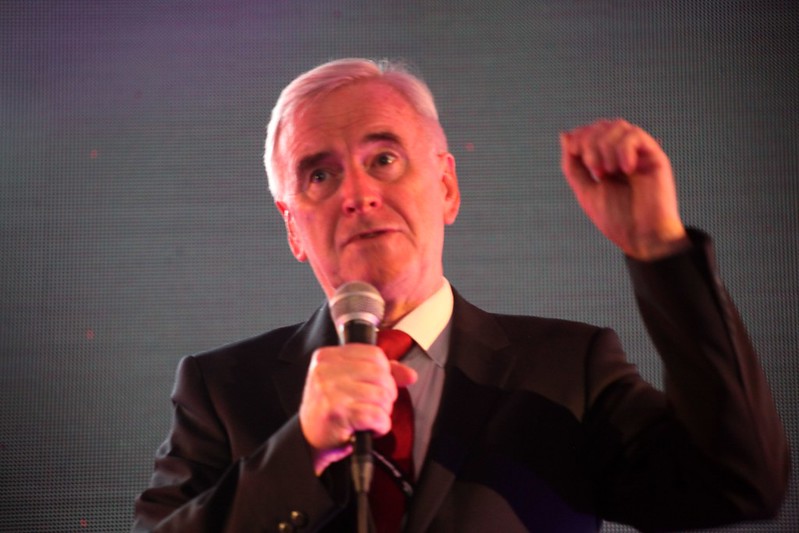
During an interview with Iain Dale last night in Edinburgh, the Shadow Chancellor, John McDonnell, suggested that he “might want to invent” a law to try Conservative MPs as “social criminals”, upon being reminded of an earlier phrase he had used. Mr McDonnell is said to have shrugged at the reference, remarking that he was “angry” at the time and that it was “after the first round of benefit cuts”.

The quote in question was apparently from a Unite the Resistance conference in November 2012, in which McDonnell addressed the delegates as follows:

It would seem that the Shadow Chancellor has not changed his mind on this stance in the intervening 7 years. Clearly, no such law exists at present.

Elsewhere on the UK political scene, the Foreign Secretary, Dominic Raab, met US President Donald Trump yesterday for a “preliminary chat”, during which they reportedly discussed issues such as trade and security. Mr Raab later told reporters that the President had a “huge appetite” for a free trade deal with the UK, saying that he was “effusive in his warmth” towards the UK and expressed “high regard” for the Prime Minister, Boris Johnson.

Given that the Foreign Secretary was in fact in the White House to meet Mike Pence, the Vice President, and that the meeting with Mr Trump in the Oval Office was impromptu and unscheduled, the move has been interpreted as a bid to rekindle US-UK relations. This follows a scandal revealed last month involving leaked diplomatic cables from the UK’s former Ambassador to the US, Sir Kim Darroch, in which he claimed that Mr Trump’s administration was “inept” and “utterly dysfunctional”.

Mr Raab said: “It’s amazing to hear an American president talk about our country in such warm terms. He expressed his high regard for Boris Johnson as a Prime Minister.

“We talked about all the things that we want to do together in the post-Brexit vision for the UK, whether it’s getting a free trade deal done and there’s obviously going to be a lot of work to make that happen. There’s a huge appetite on both sides to achieve that.

“And then all the range of security issues that we share in common and want to make sure we strengthen the relationship and build our capacity to tackle those issues together.”

Meanwhile, The Express carries a story today suggesting that the Taoiseach of the Republic of Ireland, Leo Varadkar, is on course for a “Brexit showdown” with Boris Johnson, in the run-up to a planned meeting between the two.

We also read in The Independent today that Dominic Cummings, now an advisor to the Prime Minister in Downing Street, has given his first media appearance since his new appointment, telling reporters that “politicians don’t get to choose which votes they respect”.

Legal challenge launched against PM proroguing Parliament, Labour says it would not block IndyRef2

6 August 2019 | UK NEWS

A cross-party group of over 70 MPs and peers have launched a crowd-funded legal challenge, led by the Good Law Project, aimed at preventing Boris Johnson from proroguing Parliament in order to ensure a No Deal Brexit. The Prime Minister has committed to taking Britain out of the European Union on or by October 31st, with or without a deal.

The group is understood to include MPs such as Jess Phillips (Labour), Joanna Cherry (SNP) and Jo Swinson (Lib Dem Leader). They have petitioned the Court of Session in Scotland to issue a ruling that the PM cannot lawfully ask the Queen to prorogue Parliament in this situation.

The legal papers they have lodged with the Court give their position that “seeking to use the power to prorogue Parliament to avoid further parliamentary participation in the withdrawal of the UK from the EU is both unlawful and unconstitutional”. They further add that “the exercise of the power of prorogation would have irreversible legal, constitutional and practical implications for the United Kingdom”.

No date has yet been set for hearing the case, although it is understood that the plaintiffs have urged the Court to consider the seriousness of their case “as a matter of urgency”, given that Britain is due to leave the EU in less than three months’ time.

In other news relating to affairs in Scotland, the Shadow Chancellor, John McDonnell, has announced that a future Labour Government would not seek to prevent a second referendum on Scottish independence from the UK, should one be requested by the Scottish Government. Mr McDonnell said: “It will be for the Scottish Parliament and the Scottish people to decide that. They will take a view about whether they want another referendum. Nicola Sturgeon said by late next year or the beginning of 2021.”

He added: “We would not block something like that. We would let the Scottish people decide. That’s democracy. There are other views within the party, but that’s our view.”

However, the Scottish Labour Leader, Richard Leonard, reportedly takes a different view. Speaking during a BBC interview on Sunday Politics Scotland back in March, he said: “What we said in the manifesto at the 2017 election was that there is no case for, and we would not support, a second independence referendum.” He further added categorically that a Labour Government would refuse a ‘Section 30 order’, this being the instrument by which the UK Government in Westminster would authorise Holyrood to organise a second referendum.

Elsewhere on the UK political scene, we read in The Guardian that former Labour MP Fiona Onasanya has been struck off as a solicitor following her conviction for perverting the course of justice over a speeding fine.

The Telegraph also carries a story today reporting the Alan Johnson, a former Labour Home Secretary, has said that Jeremy Corbyn is a “total disaster” on Europe, adding that “practically anyone” could lead the Party more effectively.

Tensions heighten around No Deal Brexit amid BoE and Scots Govt warnings

2 August 2019 | UK NEWS

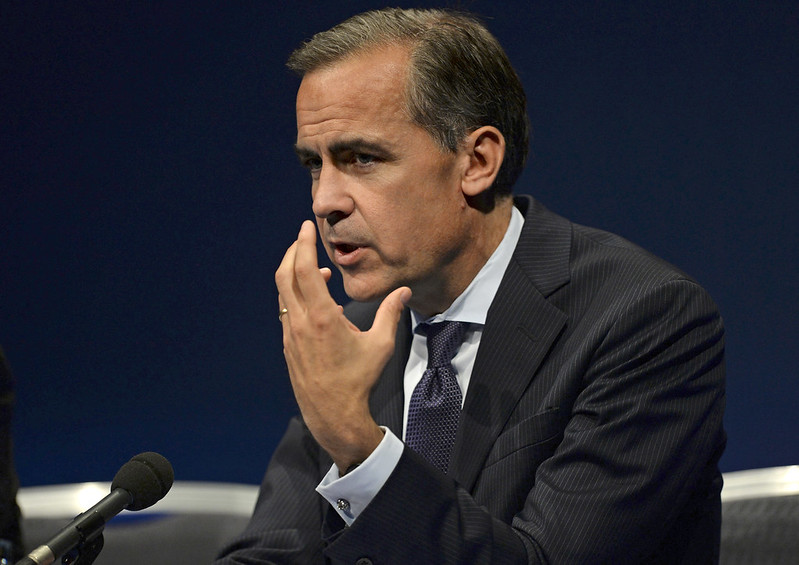
The Governor of the Bank of England, Mark Carney, has issued renewed warnings about the anticipated economic impact of a No Deal Brexit today, in comments made on the Today programme earlier today. Citing increased prices for motorists and consumers across the country, Mr Carney also voiced concern about the continued profitability of a “substantial number” of UK firms.

Mr Carney was responding to further optimistic overtures around Brexit emanating from the new team in Downing Street, as well as to the leak of a Government presentation slide said to have been prepared in the final few weeks of former Prime Minister Theresa May’s administration, which was classified ‘OFFICIAL-SENSITIVE’ and obtained by Sky News. The document outlined the potential ‘worst-case’ scenarios in the categories of First Day, First Fortnight and First Month.

Describing the potential ramifications of these scenarios, Mr Carney said: “The economics of no-deal are that the rules of the game for trade – exporting to Europe or importing from Europe – fundamentally change.

There are some very big industries in this country where that which is highly profitable becomes not profitable, becomes uneconomic, and very difficult decisions will need to be taken. That has knock-on effects on the economy in the short term.”

Adding that the economic shock would be “instantaneous”, he further told Today: “One would expect prices to go up. It’s reasonable to expect, the markets are absolutely clear on this, that in the event of no-deal the exchange rate would go down for a period of time. And the area of the economy where that instantly translates into prices – it’s at the forecourt of the petrol station and in fruit and veg.”

Wolves understands that the document in question was shown to Ministers at the time, but had not yet been ‘signed off’ as official Government policy. It warns of potential friction between UK and EU fishing vessels at sea, and suggests that cross-border agricultural trade along the NI/RoI border could “virtually stop”, while other trade may slow.

It further predicts, under the category of First Fortnight, that there could be “potential consumer panic and food shortages, even in areas which are not directly affected at the border.” There may also be a “possible increased risk of serious organised crime including people smuggling and illegal migration”. Within the First Month, it anticipates an “unsustainable” situation for heightened policing resources, with problems growing as operational security gaps “continue to emerge”.

Mr Carney’s comments earlier today came amid reports from north of the border that the Scottish Government is also preparing to ramp up its efforts to mitigate a No Deal Brexit. Warning that the Scottish economy would be “seriously damaged” as a result, which would “inevitably cause disruption”, First Minister Nicola Sturgeon said: “In its first week, the UK Government has shown it is willing to risk a No Deal Brexit. Taking Scotland out of the EU in any way is deeply undemocratic but the Prime Minister’s refusal to engage with the EU has dramatically increased the prospect that we will face a deeply damaging No Deal Brexit.”

She added: “If the Prime Minister continues with this approach, Scottish jobs will be lost and our economy seriously damaged, and it will be entirely the UK Government’s responsibility. Having assessed the actions of the new UK Government our work to prepare for No Deal will intensify in the coming weeks and months.

But even with the best possible preparations, leaving the EU without a deal will hurt Scotland’s businesses, disrupt trade and impact on all aspects of society. There is simply no way to mitigate every impact that no deal will have, no matter how hard we try.”

Ms Sturgeon further highlighted her commitment to a second referendum on Scottish independence, adding: “The willingness of the UK Government to pursue this approach, against all the evidence, shows why we must continue to make preparations for a referendum that will give people the right to decide Scotland’s future instead of being dragged out of the EU against their will.”

The First Minister’s comments came following a meeting of the Scottish Cabinet earlier today, in which it resolved to step up its preparations for a No Deal Brexit, having concluded that Prime Minister Boris Johnson’s refusal to re-open negotiations with the EU for as long as it fails to countenance any further alterations to the existing Withdrawal Agreement will only make a No Deal Brexit ever more likely.

Elsewhere on the UK political scene today, we read in the London Evening Standard that the veteran ex-Labour MP Frank Field, currently sitting as an independent in Parliament, has announced that he will stand for his own Birkenhead Social Justice Party in the next General Election, ruling out standing again for Labour while “anti-Semitism” and “nastiness” continue within its ranks.

Meanwhile, US President Donald Trump has reportedly discussed trade and security with Prime Minister Boris Johnson in a phone call yesterday, according to The Guardian. Mr Trump is also said to have urged Mr Johnson not to use technology from Chinese tech giant Huawei in any of its 5G mobile networks – a stance that the US is keen to push with all its allies.

New Scottish Secretary once backed Scots Tory breakaway group, Boris gets cold shoulder in Scotland

29 July 2019 | UK NEWS

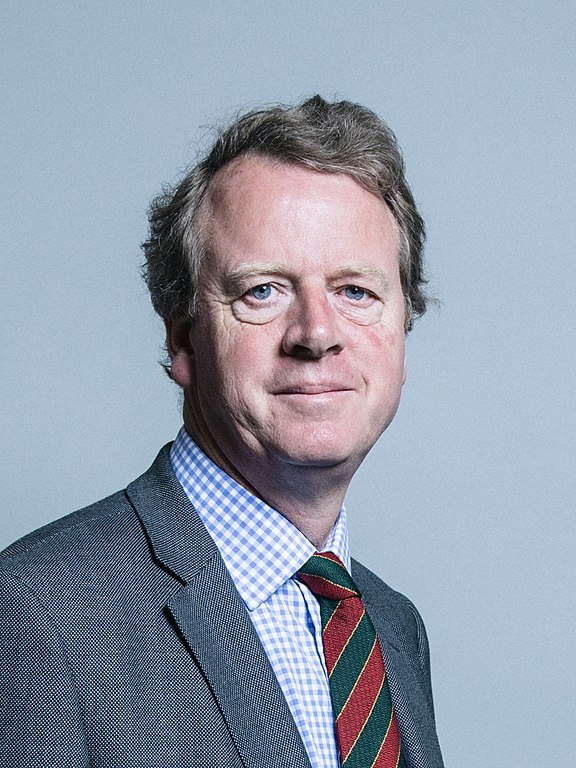
Reports have surfaced today that the new Secretary of State for Scotland, Alister Jack, once advocated a plan to produce a breakaway group of small-C conservatives in Scotland. Speaking in 2011, Mr Jack is reported to have said “we shouldn’t be frightened of stepping out on our own” in relation to a radical proposal to abolish the Scottish Conservatives north of the border.

It comes amid reports that the present Leader of the Scottish Conservatives, Ruth Davidson, has great reservations about the prospect of a Boris Johnson-led government. Ms Davidson was said to have been angered by Mr Johnson’s sacking of her former ally, David Mundell, as Secretary of State for Scotland, ahead of her meeting with him today.

Mr Johnson is also said to have endured a frosty reception when meeting Nicola Sturgeon, the SNP’s First Minister of Scotland, earlier today. He was reportedly booed by anti-Brexit and pro-independence activists as he entered her official residence, and Ms Sturgeon later said that the country’s new administration was “secretly pursuing a no-deal Brexit”. The Prime Minister is said to have left her residence by the back door following their meeting.

In the Republic of Ireland, Sinn Fein have accused the Prime Minister of being “discourteous and offensive” in his failure to contact the Taoiseach, Leo Varadkar, since entering Downing Street. Accusing Mr Johnson of “snubbing” the Taoiseach, its Vice President, Michelle O’Neill, said that she had raised the matter during a meeting with the new Secretary of State for Northern Ireland, Julian Smith, earlier today. She added:

“I would judge that it is highly discourteous that the new Prime Minister Boris Johnson is not engaging with the Taoiseach. That is highly offensive given the disastrous impact of Brexit on the island of Ireland.”

Returning to continental affairs, The Daily Mail reported today that the Prime Minister has no plans to travel to European capitals in order to conduct further negotiations to avoid a no-deal Brexit.

Meanwhile, The Mirror carries a story suggesting that the Cabinet Office inquiry into the allegations that Mark Field, a former Foreign Office Minister, manhandled a protester during a dinner last month has been dropped by the Prime Minister, given that Mr Field had already lost his job as a result of the affair and this was “a matter for the previous PM”. At the time, we at Wolves ran an opinion piece by Elena Bunbury, the Young Conservative activist and MP candidate who also introduced Jeremy Hunt at the final Conservative Leadership hustings, here.

Boris Johnson rules out early election, discusses US trade deal with Trump

26 July 2019 | UK NEWS

The Prime Minister, Boris Johnson, has ruled out calling a General Election ahead of schedule in 2022, seemingly in an attempt to deflect speculation that he would go to the country in the autumn ahead of Britain’s scheduled departure from the European Union on October 31st.

Speaking at an event in Birmingham, Mr Johnson said: “The British people voted in 2015, in 2016, in 2017. What they want us to do is deliver on their mandate, come out of the EU on October 31. They don’t want another electoral event, they don’t want a referendum, they don’t want a General Election. They want us to deliver.” He also said that he would “absolutely not” call an early General Election.

The Prime Minister expressed his view that the Withdrawal Agreement, as negotiated between Theresa May and the European Commission, was now “dead” and that the UK would definitely leave the EU on Halloween regardless of the circumstances. In response, we at Wolves understand that Mr Johnson has been rebuffed during initial conversations with the French President and the German Chancellor, who reportedly insisted that the WA could not be re-opened or re-negotiated.

Meanwhile, the Prime Minister has also been in talks with the US President, discussing the “unparalleled” opportunities for trade after Brexit. Referring to the potential for strengthening the economic partnership between the two countries, a Downing Street spokesman said: “The leaders both expressed their commitment to delivering an ambitious free trade agreement and to starting negotiations as soon as possible after the UK leaves the EU.”

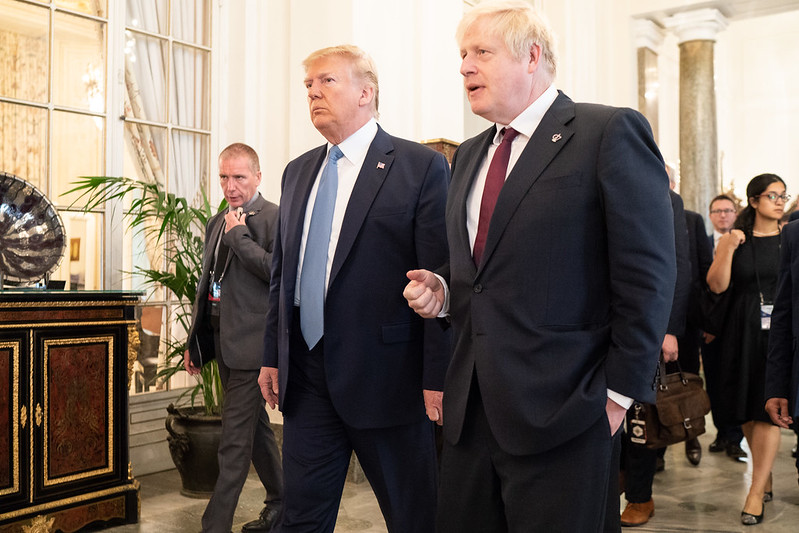
Mr Trump reportedly used the call to congratulate the new Prime Minister on his election victory, and the two leaders are also said to have discussed the situation in Iran. They will meet for the first time as President and Prime Minister at the G7 Summit in Biarritz next month.

In the newspapers today, we read in The Telegraph that the former Deputy Prime Minister, Nick Clegg, stands accused of claiming over £100,000 in expenses from the Public Duty Cost Allowance fund in 2018/19, despite being in the lucrative employ of Facebook for almost half of last year.

Elsewhere, The Guardian carries a story reporting that the new Home Secretary, Priti Patel, may have breached the Ministerial Code for a second time since her resignation as International Development Secretary in 2017. The allegations relate to work she has been carrying out this year that had not yet been cleared by the Advisory Committee on Business Appointments (Acoba).

A Conclusion to the Shameful Scruton Affair? – Michael Curzon

25 July 2019 | OPINION
This article has been republished from here with permission.

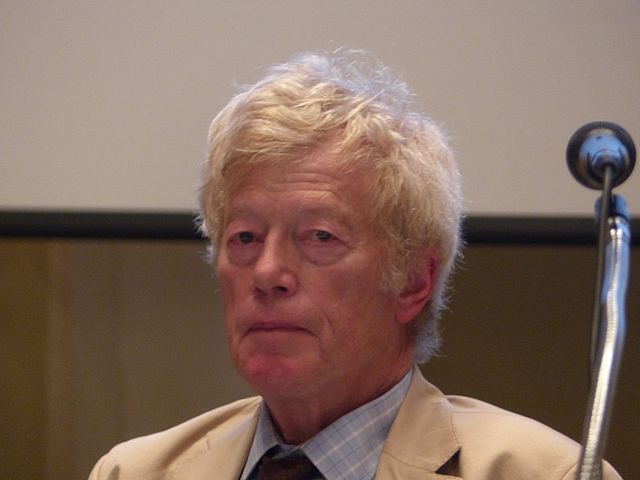
Sir Roger Scruton has been reappointed head of the Government’s ‘Building Better, Building Beautiful’ commission. He was sacked from the body in April due to his views being seriously manipulated after an interview with the ‘New Statesman’ magazine.

I am impressed that Sir Roger Scruton has accepted an invitation from Housing Secretary James Brokenshire (responsible for sacking him in April) to be reappointed back to the Building Better, Building Beautiful commission, as co-chair alongside Nicholas Boys-Smith.

It would have been very easy, and quite understandable, for Sir Roger to stick his two middle fingers up to this suggestion, after his recent treatment by the government. Understanding the great need for a shift in focus for building in Britain, however, he rose above this natural reaction of anger and so will be back to work with the commission shortly.

I will not regurgitate the doings of this affair here; Jake Scott, the avid follower of Sir Roger and his work that he is, has written at length on this topic for the third print issue of Bournbrook Magazine, and a statement from Sir Roger appears (to our delight) in the fourth.

It is, however, worthwhile reflecting on the state of the Government, and the wider Conservative Party, in light of this.

That the Government sacked Sir Roger without bothering to investigate the truth behind clearly misrepresented semi-quotes is immensely incompetent. This suggests it is more interested in pandering to the Twitter mob (hell-bent on ruining the career of Sir Roger) than in upholding the truth.

This is made all the worse by the way the Government handled its actions. Indeed, a timeline produced by Sir Roger shows James Brokenshire only properly contacted him whole weeks after he foolishly issued Sir Roger’s sacking. Even then, Mr. Brokenshire only referred to ‘the Twitter storm and a selected single phrase as a justification to his decision’ (from the timeline). Was any of this properly thought out, or is the party incapable of thought altogether?

It is also worrying that, while a few Conservative Party MPs did speak out in defence of Sir Scruton, most remained silent, or even added to the attacks.

This adds to my belief that the party is hostile against conservative thought. The election yesterday of a man who – in both his political and private life – is the very antithesis of conservatism, does not fill me with any more hope.

More from this author

Don't miss...

Wolves of Westminster