Home Blog Page 68

Live: Conservative Leadership – Round 2 MPs Vote

18 June 2019 | UK NEWS

17:50: We are now awaiting the results for the second round of the Conservative leadership contest.

The secret ballot, which closed at 17:00, is currently being counted and around 18:00 we shall find out who has managed to secure that magic number of at least 33 votes.

Boris Johnson, who stormed to victory in the first round of voting, is expected to make a few more gains with the likes of Matt Hancock and Andrea Leadsom coming on baord to support him.

It has also been reported that the Environment Secretary, Michael Gove, has lost one or two supporters to Boris, so could we see Mr Gove slip into a dangerous position?

18:06 – Results: Live results as they come in from the Palace of Westminster…

* Next to their name means they have been eliminated from the race.

Michael Gove – 41 votes

Jeremy Hunt – 46 votes

Sajid Javid – 33 votes

Boris Johnson – 126 votes

*Dominic Raab – 30 votes

Rory Stewart – 37 votes

Summary: The results are in and as expected Boris Johnson has yet again won by a country mile. However, the “people’s politician”, Rory Stewart, has doubled his vote from last time securing 37 votes to overtake both Dominic Raab and Sajid Javid.

It will now be a question of who Mr Raab and his supporters will be getting behind. Could we see Sajid Javid drop out from the race and get behind Mr Stewart?

Looking forward to the debate this evening, all 5 candidates will be present at the lecterns with Emily Maitlis chairing tonight’s affair. It will be Boris Johnson’s first appearance in a debate since hustings began. He was absent from Channel 4’s debate on Sunday evening, where Rory Stewart seemed to come out on top.

Further analysis has been posted here.

Jeremy Hunt: Why I’m backing him and why you should too – Callum Murphy

17 June 2019 | OPINION

Our Party and our country stand on the edge of a precipice and whilst there are some within the ranks of our membership who believe our electoral fortunes can be solved with a quick shot of political Viagra, I believe we need to approach this leadership election seeking a candidate who has the ability to negotiate a Brexit deal and who also has a long-term vision to challenge the prevailing political ethos, which is why I am backing Jeremy Hunt.

Our starting point to be able to restore the Conservative Party’s reach with the wider electorate must be to deliver on Brexit. Whilst I applaud the spirited debate that has ensued so far throughout the contest, I despair at the prospect put forward by some that the only answer to the Brexit deadlock is either to walk away at one extreme or go back to the electorate via a citizens’ assembly at the other extreme. Both of these options are the wrong approach. Whilst Britain has spoken and, almost 3 years to the day, Britain is still waiting for Brexit to be delivered, we need our Government and our next Prime Minister to take a lead.

Only Jeremy Hunt has shown any form of credible plan to ensure that Brexit is delivered and he is the only credible candidate with the skill at negotiation to make other European leaders come back to the table and engage.

As a starting point, Jeremy will clear out the failed technocrats, take a European Union approach and send a fresh new team of politicians to the negotiating table to hammer out a solution to the Northern Irish backstop which has so harmfully divided our Party. Jeremy’s instinctive belief in democracy demonstrates his belief in Brexit, but more importantly his life’s work as a negotiator and an entrepreneur make him the right leader to be able to unite a divided Parliament, make the European Union negotiate and fully prepare our country for the opportunities which lie ahead as a more outward-looking and global nation.

Throughout this whole contest, one thing my fellow Conservative Party members should not lose sight of is that it is not all about Brexit. It is also about the Conservative Party redefining a narrative with the public to prevent a disastrous and ruinous Labour Party from wreaking havoc with our economy – Venezuelan style, and that is why Jeremy Hunt is more perfectly placed than other candidates in the field to meet this challenge and restore our political credentials with the public.

Jeremy is a man across all departments and – unlike the other candidates – has a fully costed coherent plan to grow the British economy and get public services moving again. His pledge to cut corporation tax to Irish levels will make Britain the most pro-business economy in Europe and will ensure Britain’s Foreign Direct Investment continues to grow, raising our stagnant GDP. This is the most holistic way we will find more money for our public services – such as the NHS – and still be able to cut taxes for ordinary hard-working people, all things that the Conservatives want to do.

The last thing we need as a Party at this juncture is a general election, but from this point onwards we need to be preparing for one with an eye on 2022. We need to start by overhauling our campaigning reach, and as the only candidate in this race to have turned a marginal seat into one that now has a 21,000 majority, this proves Jeremy Hunt knows how to win. He is the obvious unity candidate, not just for our Party, but for the entire Country, as shown by his eagerness to deliver a Brexit that works for everyone, including the 48% who voted to Remain.

Jeremy’s natural ability to bring people with him and take on board the views of others shows he will able speak to all parts of the United Kingdom. He will appeal to people from all backgrounds and age groups, widening the Party’s appeal, defeating Corbyn and ensuring the prosperity and security of this great Country.

For the first time in our history as a political party, we are being asked not just to pick a Party leader, but also the next Prime Minister of our country. This requires us as Conservative members to ask who the best person for the job is. To do this objectively, we have to look at the realities of the candidate’s records and not be blinded by empty rhetoric or façade. Over the last year, Jeremy has been a first-class Foreign Secretary campaigning hard for British interests, and has proven to be a true statesman and patriot; someone who believes in Britain and will deliver in the national interest.

With a background in business and nearly 15 years in politics, Jeremy has the experience of negotiation needed to make him the right person to fight our corner against the EU. Beyond Brexit, his economic vision is ambitious – encompassing all of the opportunities a global Britain can be. As a Young Conservative, I am inspired by Jeremy’s vision and I am confident he will restore the fortunes of our great Party, but more fundamentally I also believe he will lead our country out of the EU and towards a more prosperous future to reclaim our position on the global stage.

Dominic Raab: The Great Tory Tax Reformer of the 2020s?

17 June 2019 | OPINION

Dominic Raab may not become the next Prime Minister of this country, but if his tax proposals were introduced, it would give the party a desperately needed post-Brexit vision. We need to remember that we are most successful when we are a low-tax party, as this is the foundation of what we stand for as Conservatives. Looking forward to the 2020s, we need to continue to strive towards a low tax, high wage and low welfare society. ‘A vision for the 2020s’ is an unused phrase. Raab’s tax proposals offer the Conservatives the opportunity to claim this for our own.

It is important to remember that the Conservative Government has made positive progressive changes on tax. If you manage to get past the self-indulgent finger wagging of The Guardian, the left-wing protesters and the Twitterazi, there has clearly been a determined effort by this government to improve the life chances of the many. This has primarily been by cutting income tax. Over 30 million taxpayers have benefited from increasing the personal allowance from £6,475 in 2010 to £12,500 in April 2019. This means basic rate tax payers are paying over £1,200 less income tax than 9 years ago.

It is ridiculous when commentators suggest this tax cut disproportionately helps high earners, as it proportionately helps lower earners much more. When I was earning £15,000 a year working in jobs such as a support worker in a homeless hostel, this ongoing tax cut was hugely beneficial.

Even with this fantastic policy, the tax burden is still the highest it’s been for over 30 years. If we are to differentiate ourselves from Labour on tax, we need to adopt Raab’s tax plans without hesitation. With the government now running a surplus on day-to-day spending, we have the fiscal headroom to allow people to keep more of their own money. Raab’s first tax priority would be to raise the National Insurance threshold from just over £8,000 to match the personal allowance at £12,500. This would mean an extra £460 to low and middle earners – a hugely progressive policy.

Following the changes to National Insurance, the aim is to cut income tax by 5p over 5 years. This would clearly show a direction of travel from the Conservative Party, although Raab has made it clear that it wouldn’t be funded by more borrowing. This may mean higher taxes on unproductive wealth or further savings elsewhere. Even if this were the case, cutting income tax would still be a hugely popular move, as people would see their real pay increasing on a monthly basis.

The current government has made good progress in moving our country to a lower income tax, higher wage, lower welfare economy. With the budget deficit at sustainable levels, we should now go further and cut taxes for lower and middle earners. Raab’s tax polices offer the Conservatives a mission beyond Brexit that we should whole-heartedly embrace.

As Conservatives, we must never forget that we believe that taxpayers know how to spend their own money better than any government.

Matt Hancock withdraws from Tory leadership race, Chuka Umunna joins Lib Dems

14 June 2019 | UK NEWS

Matt Hancock, the current Health Secretary, has become the latest contender in the Conservative Party leadership election to withdraw his candidacy. This follows the results of the first round of MP voting, which were held yesterday morning with the result announced at around 1pm. Mr Hancock received 20 votes in this round, placing him 6th overall as things stood on Thursday afternoon.

In a statement, Mr Hancock said: “I ran as the candidate of the future, but the party is understandably looking for a candidate for the unique circumstances we face right now”. He did not indicate which of the other contenders might now receive his backing in the next round of voting, which will be held this coming Tuesday, although he did add that he was “talking” to each of them.

Elsewhere on the UK political scene, Chuka Umunna left his struggling party of Change UK today and joined the Liberal Democrats. It comes in the aftermath of the party’s split earlier in the month, with a number of MPs choosing to become The Independent Group once more. Mr Umunna said he had been “wrong” to think that “millions of politically homeless people … wanted a new party”.

He added that he had “massively underestimated just how difficult it is to set up a fully fledged new party without an existing infrastructure”, but also ruled out calling a by-election in his constituency of Streatham. He did not immediately throw his weight behind either Jo Swindon or Sir Ed Davey to be the next leader of the Lib Dems.

The move has prompted scrutiny of Umunna’s past utterances on the topic of the Lib Dems, including when he said on Twitter in April 2017 that he could not forgive them for what they had “done to my area”. Prior to this, in September 2013, he had said that “you can’t trust a word the Lib Dems say”. His former colleague in Change UK, Anna Soubry (who is now its leader), later said that Umunna had made a “very serious mistake” in quitting the fledgling party.

In the newspapers today, The Guardian reports that the stand-out lead candidate in the Tory leadership election, Boris Johnson, has said he will appear in a BBC TV debate, although he also turned down a similar offer from Channel 4.

Meanwhile, The Express carries a story reporting that the outgoing Prime Minister and current Acting Leader of the Conservatives, Theresa May, is said by close friends to become emotional when the topic of her future is raised*.

* Perhaps understandably! – Ed.

Overwhelming victory for Johnson as battle for second hots up

13 June 2019 | UK NEWS

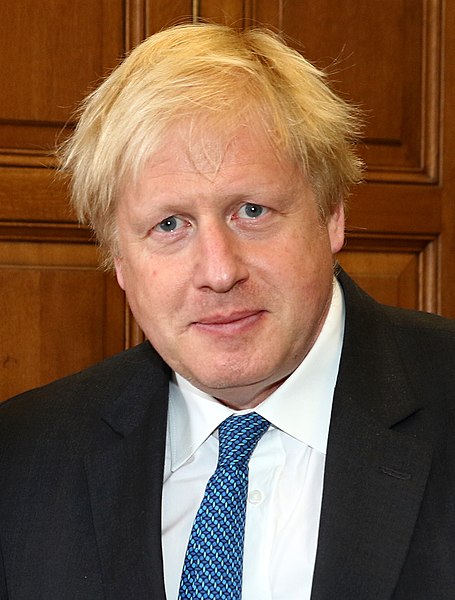
Boris Johnson has secured an overwhelming victory today in the first round of the Conservative Party leadership contest. The former Foreign Secretary and backbench MP received 114 votes from Tory MPs, which with a lead of 71, means that Mr Johnson is already seeming like a likely contender for the final round.

However, there is still a long-way to go before either Mr Johnson or anyone else can pick up the keys to Number 10. For anyone who missed the results earlier today, here is a very helpful ‘Wolves Breakdown’.

Conservative Party Leadership – Round 1 – Results:

* Next to the name means they have been eliminated and have failed to meet the criteria of 17 votes in the secret ballot.

Boris Johnson – 114 votes

Jeremy Hunt – 43 votes

Michael Gove – 37 votes

Dominic Raab – 27 votes

Sajid Javid – 23 votes

Matt Hancock – 20 votes

Rory Stewart – 19 votes

Andrea Leadsom* – 11 votes

Mark Harper* – 10 votes

Esther McVey* – 9 votes

This means that both of the female candidates, Leadsom and McVey, have now been eliminated – Britain’s next Prime Minister is now certain to be male. The second round of voting shall take place on June 18th with leadership hopefuls this time needing to secure 33 votes in order to stay in the race.

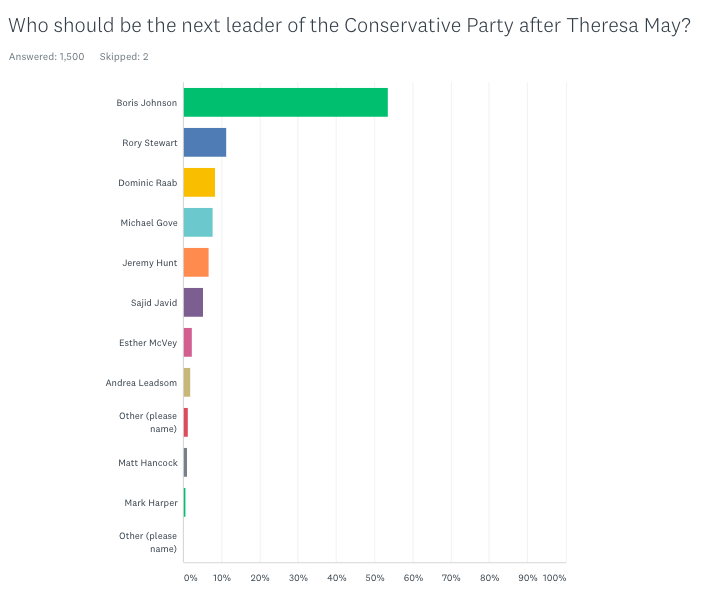
This will prove to be a tall order for International Development Secretary, Rory Stewart, who currently sits at 19 votes. However, in an interview with the BBC, Mr Stewart mentioned that a recent ConHome poll showed him second place behind Mr Johnson when it came to membership support.

Despite this being true, the margin between Rory and Boris speaks for itself…

Credit: ConservativeHome

As Boris Johnson looks to be a favourite for the final membership vote, the race for who will stand against him is hotting up between Jeremy Hunt and Michael Gove. Currently, Hunt leads Gove by 6 votes, so the question is which MPs from Leadsom, Harper and McVey’s camps will jump on either Michael’s or Jeremy’s bandwagon, and whether this be enough to play catch-up with Boris.

Finally, Tory MP Sir David Amess has voiced his disappointment with the low turnout to discuss the current housing crisis. He said he was “embarrassed” that Tory MPs were more interested in a leadership race then giving speeches in parliament.

Sir David echoed what for many has been a concern for the past two years as he said: “I can understand the excitement, certainly in my party, because of the results being declared upstairs, but Parliament isn’t working well, and I am increasingly worried about this because, if we are in a situation whereby the country and Parliament is split, we are just going to have to accept it and get on with the work. And I do want to see Parliament functioning.”

The question now being: whoever takes up the role of Prime Minister over the next month, will they be able not only to reunite the country but to move the conversation on from focusing on Brexit?

Opposition Day motion defeated, Johnson & Javid launch leadership bids

12 June 2019 | UK NEWS

An Opposition Day motion tabled by Labour, proposed by the leaders of the Labour Party, the Liberal Democracts and the SNP (among others), has been defeated in the House of Commons tonight by 309 votes to 298. 10 Conservative Members rebelled against the Government to vote for the motion, while 8 Labour Members likewise rebelled to vote against it.

The motion would have suspended Standing Order 14 on 25 June, thereby removing the Government’s ability to control the Business of the House on that day. As with previous successful motions in March and April this year, it would have enabled MPs from across the House to take control of the Parliamentary agenda for that day and table a motion “in connection with matters relating to the United Kingdom’s withdrawal from the European Union”.

It is thought that this opportunity would have been used to propose measures to prevent a future Tory Prime Minister from pursuing a ‘no deal’ strategy in respect of Britain’s departure from the EU.

Elsewhere on the political scene today, Boris Johnson has launched his campaign to accede to the Premiership, pledging to take Britain out of the EU by the end of October at the latest. He said that, in his view, ‘no deal’ should be left on the table as “a last resort”, adding that “after three years and two missed deadlines”, this was now a necessity.

During his speech, he also said: “Delay means defeat, delay means Corbyn. Kick the can again and we will kick the bucket.”

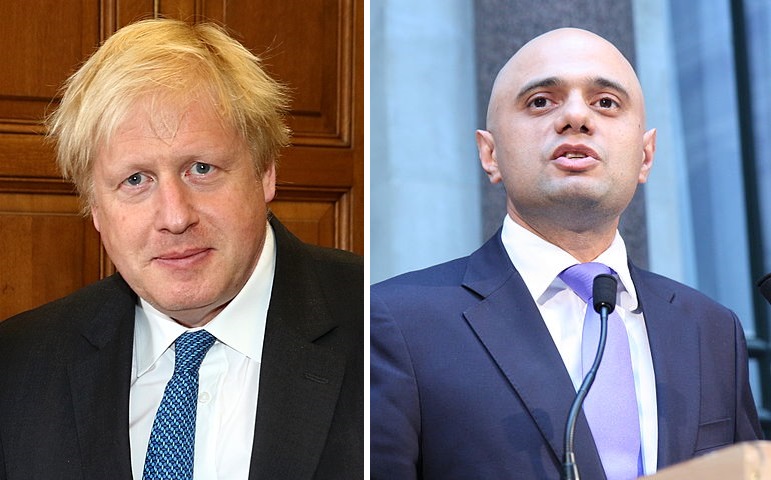
Mr Johnson’s leadership rival, Sajid Javid, also launched his campaign today, saying that Boris Johnson was “yesterday’s news” and positioning himself as a “new kind of leadership” offering a credible plan to deliver Brexit. He said in his speech that “if we’re trying to connect with the next generation and move forward as a country then I think it’s time for the next generation with a bold new agenda.” He added: “That means understanding that we cannot call ourselves a ‘one nation’ party, if there are whole swathes of this country that don’t think that we share their values and their needs.”

In the newspapers today, The Express reports that Dominic Grieve has pledged to leave the Conservative Party and bring down the Government in order to stop ‘no deal’ if necessary, saying that he “would not hesitate” to do so.

The Guardian carries a story reporting that an outgoing senior British diplomat in Singapore has stated that Brexit has ruined the UK’s reputation abroad, commenting on “the lasting damage that has been done to the UK in the eyes of Singaporeans”.

Conservative leadership election kicks off with 10 contenders

10 June 2019 | UK NEWS

The Conservative Party leadership contest has officially begun, with 10 contenders at the outset following Sam Gyimah’s withdrawal earlier today. The full list of candidates is as follows:

Boris Johnson (former Foreign Secretary) | Dominic Raab (former Brexit Secretary) | Jeremy Hunt (Foreign Secretary) | Michael Gove (Environment Secretary) | Matt Hancock (Health Secretary) | Mark Harper (former Chief Whip) | Esther McVey (former Work & Pensions Secretary) | Sajid Javid (Home Secretary) | Andrea Leadsom (former Leader of the Commons) | Rory Stewart (International Development Secretary)

Several of the candidates have given press conferences launching their leadership bids today – further coverage of this will be posted tomorrow. Candidates will be eliminated in a series of ballots, with the first to be held this coming Thursday. Any candidate with fewer than 17 votes (or 5% of the Parliamentary party) will be automatically eliminated. The first hustings featuring all candidates before Conservative MPs, hosted by the 1922 Committee, will begin on Tuesday from 3-7pm, continuing on Wednesday from 4-6pm. No members of the press may attend.

It follows an interesting series of revelations as ConservativeHome posed the famed question to all the leadership candidates in a series of interviews: “What is the naughtiest thing you have ever done?” Several of the leadership candidates confessed to having tried illicit substances earlier in their lives, as reported by Guido Fawkes.

Meanwhile, in the Labour Party, The Guardian reports that tonight’s meeting of the PLP was Jeremy Corbyn’s “worst meeting as leader”. It cites reports that Mr Corbyn did not “seem to acknowledge that there were difficulties”, including around Brexit, anti-Semitism and sexual harassment claims.

Elsewhere, following an announcement from the BBC that free TV licenses for over-75s are now to be scrapped, The Telegraph carries a short piece questioning the wider sustainability of the license fee model, given that overall consumption of BBC content is falling.

Boris Johnson: The man Young Conservatives like me should get behind – Jason Reed

10 June 2019 | OPINION

For all that has been made of the sheer volume of wannabe leaders who have spent the last few weeks parading themselves in front of us, and irrespective of the ridiculousness of the narcotics top trumps, policy discussions in this leadership contest have been delightfully sensible and nuanced, especially on Brexit. Setting aside outliers like People’s Voter Sam Gyimah and people’s champion Rory Stewart, the only real dividing line between the candidates on Brexit is whether or not they are willing to countenance No Deal.

Boris Johnson is the unifier that the Conservatives need. The fact that he has won endorsements from Tory ultra-Brexiteers Steve Baker and Priti Patel whilst also enjoying support from “centrism” enthusiast Johnny Mercer (and a host of other moderates) speaks to his unique ability to bring Conservatives together behind a common desire to get Brexit done and a shared vision of a booming post-Brexit Britain.

A logjam in a hung parliament, combined with a rogue Speaker and an electoral populist explosion that is making the polls more volatile than the stock markets, means that pragmatism is an inescapable necessity. Rory Stewart may be the candidate preaching compromise and realism the loudest, but the only person truly putting that into action is Boris Johnson. Johnson’s entirely sensible, down-the-middle approach to Brexit is perfectly balanced to drag Britain through this crisis once and for all by winning back Conservative defectors from all directions.

Johnson intends to stare facts in the face and get to the bottom of Michel Barnier’s stern rhetoric once and for all by implementing a long-awaited now-or-never approach to Brexit: if substantial alterations to the Withdrawal Agreement are not offered in the coming months, we leave without a deal in October. Either way, by the end of the year, the all-consuming issue of Britain’s relationship with Europe will, with a bit of luck, have largely dropped off our national radar. Our political bandwidth will be freed up for the first time in years for exploring other pressing issues like violent crime, school funding and the environment.

On the fundamental point that pursuing a Hallowe’en Brexit is vital for both party and country, the candidates are broadly in agreement. Even Rory Stewart, who has momentarily captured the yearning gazes of the long-abandoned Twitter politicos, acknowledges that we should seek to leave the EU quickly and quietly.

Stewart is viewed admiringly by many as the brave compromise candidate, valiantly speaking the truths no one else dares confront. His ideology is a refusal to have an ideology. By beating everyone else to the punch and entering the leadership contest long before it began, he was able to seize the momentum and present himself as the voice of sensible Conservativism. When it comes to his actual policy pledges, though, his approach is terrifyingly creative.

He may have ruled out a second referendum, but Stewart has no qualms about circumventing democracy by simply ignoring the will of Parliament. His fetish for citizens’ assemblies is questionable, to say the least, and his bizarre assertion that a variation of the Duke of Edinburgh award should be compulsory has raised many eyebrows. This is in addition, of course, to his markedly unpragmatic commitment to taking No Deal off the table. He is not the compromise candidate – Johnson is.

Despite polling poorly with my fellow young Conservative members, Johnson remains the strong frontrunner to take up the leadership mantle next month. He has already achieved more MPs’ endorsements than any of his rivals. Perhaps the most significant of those, especially in terms of the youth vote, is that of Cabinet Secretary and freedom fanatic, Liz Truss.

Swathes of young Tories shed a collective tear when Truss announced that she would not stand in the leadership contest. Unlike Nigel Farage’s attention-hungry brand of media-driven populism, Truss’s politics truly do transcend the left-right dichotomy. She has greatly excited Tory Twitter by mirroring the thinking of neoliberal organisations like the Adam Smith Institute and promoting a youth-centric policy agenda founded on small-state conservatism and individual responsibility.

This worldview enjoys thumping endorsements from young Conservatives. In other words, liberty is the future of the Conservative party. That is why, before she dropped out, Truss was a roaring favourite for leader among us freedom-loving youngsters. The fact that she has now thrown her considerable weight behind Boris Johnson – and is therefore almost certain to take up a senior Cabinet position upon his coronation – sets him in yet stronger stead, not only to begin to heal the Brexit wounds, but to facilitate an optimistic, chin-up approach to building a bright post-Brexit future. Johnson brings together the best bits of Truss and Stewart, with a dash of Mercer and a hint of Baker, making him the candidate who can unite Conservatives of all colours behind a shared vision for a better Britain.

Given his support among both the parliamentary party and the membership, it looks inevitable that Boris Johnson will be Prime Minister by the end of next month. The obligatory caveat, of course, is that many said much the same thing in 2016. It seems safe to say that, short of a similarly extraordinary event to the one that left reporter Sam Coates visibly gobsmacked live on BBC News three years ago, Johnson will sweep to victory and, come Christmas, have executed Brexit and finally taken British politics off pause, setting us back on the road to a bright Conservative future.

Labour stave off Brexit Party momentum in Peterborough – Chris Bradford

7 June 2019 | ANALYSIS

Labour have gained the seat of Peterborough, having defeated Nigel Farage’s newly formed Brexit Party by 683 votes.

The constituency was made vacant following a successful recall petition of Fiona Onasanya. Onasanya was found guilty of perverting the court of justice. 27.64% of the electorate in Peterborough signed the petition, exceeding the 10% threshold needed to trigger a by-election.

Onasanya was jailed for three months after she lied to police about a speeding offence.

It was reported that turnout in Peterborough was 48.4 per cent. This was higher than the 35.6% turnout in the European elections, but also considerably higher than other recent by-elections. In the Newport West by-election in April, turnout was 37.1 per cent and in the Lewisham by-election last June, turnout was 33.3 per cent.

The results were as follows (change from 2017):

  • Lisa Forbes – Labour – 10,484 – 30.9% – (-17.2%)
  • Mike Greene – Brexit Party – 9,801 – 28.9% (+28.9%)
  • Paul Bristow – Conservative – 7,243 – 21.4% (-25.5%)
  • Beki Sellick – Liberal Democrats 4,159 – 12.3% – (+8.9%)
  • Joseph Wells – Green Party – 1,035 – 3.1% (+1.3%)
  • John Whitby – UKIP – 400 – 1.2% (+1.2%)

Speaking to BBC’s Andrew Neil on This Week, Ms Forbes claimed that Labour fought the elections on local issues as Peterborough had experienced massive cuts in education and policing, and that pride needed to be restored in the city. With regards to Brexit, she advocated that Labour respected the result of the referendum as the party triggered Article 50. Forbes articulated that she would vote for a deal that protects living standards, consumers and environmental standards. When pressed on a future second referendum, Forbes suggested that this was ‘way off’ at this juncture.

In 2017, Peterborough was a marginal constituency between Conservative and Labour, but this by-election emphasised that the Conservative Party faces electoral oblivion unless Brexit is resolved, either on the Tory Government’s terms or leaving without a deal. Compared to 2017, the Conservative vote share declined by a quarter, but it was not quite the catastrophe that the party experienced in the EU Parliament elections. The Conservative Party received 21 per cent of the vote, compared to the 11 per cent the party received in Peterborough two weeks ago. In fact, it could be argued that the performance of the Conservative Party in this election prohibited the success of the Brexit Party, by splitting the pro-Leave vote. The same argument could probably also be made in reverse.

The dynamics of the Tory leadership contest have not changed. The success of the Brexit Party in any electoral arena will drive Conservative leaders towards embracing a no-deal Brexit, irrespective of whether this type of Brexit is deliverable. If Brexit is not resolved by the next general election, it is perfectly foreseeable to envisage the Brexit Party coming second in many marginal constituencies ahead of the Conservative Party, which would usher in Prime Minister Corbyn. Boris Johnson could easily use the outcome of the by-election to claim that he would be able to ‘shoot the Brexit Party fox’, with a no-deal Brexit appealing to disgruntled Tory eurosceptics. This could be the recipe for defeating Labour in such marginals.

The argument that little has changed is the key soundbite from this election. Peterborough voted 61-39 in favour of leaving the EU in 2016; albeit difficult to tell due to the lower turnout, the outcome of this election does not provide evidence of any shift towards Remain. The Liberal Democrats experienced a minor increase compared to 2017, but the party was squeezed as the election was contested under first-past-the-post. Their relatively small gain did not change the complexion of the by-election.

This election was always between Labour and the Brexit Party. Emily Thornberry, Shadow Foreign Secretary, believed that Labour should move towards a second referendum despite the staunch reluctance of Jeremy Corbyn and Seumas Milne. Labour’s policy of constructive ambiguity was successful in this case as Forbes championed local politics, as opposed to having Brexit dominate the discourse ahead of the election. Unlike in the European elections, Labour support did not haemorrhage, meaning in the short-term, Corbyn does not need to make a drastic announcement in relation to a second Brexit referendum. Labour’s next steps and approach in trying to avoid a no-deal Brexit on Halloween will be determined at their party conference in September.

Momentum was with the Brexit Party – having won the EU Parliament elections, amassing 38.3 per cent of the vote in Peterborough two weeks ago. The Brexit Party’s inexperience and under-developed political machine proved detrimental in the final days of campaigning as Labour’s ground team mobilised, knowing the seat was genuinely under threat. The result in Peterborough was similar to the Eastleigh by-election result in 2013 which saw UKIP cement itself as a protest party, capitalising on mid-term disillusionment of the coalition and ultimately forcing Cameron to offer a referendum on EU membership ahead of the 2015 General Election.

While it is merely speculation now, the Brexit Party may have won the election if they had listed some policies or pledges, instead of espousing the overarching and convenient narrative that the two mainstream parties had betrayed the voters. Michael Greene outlined four pledges for Peterborough – all of which were vague as he advocated to ‘prioritise schools, further education, housing and jobs’. He tapped into legitimate societal grievances, but failed to provide any detail.

This by-election was a reminder for the Brexit Party that the rhetoric of protest and betrayal, which underpins their sole policy – to leave the EU without a deal – would not suffice in the context of Westminster elections. A local campaign is the key to success in by-elections; the Conservatives achieved 21 per cent of the vote, which was in part, a consequence of Paul Bristow’s personal competence. Brexit did not dominate Bristow’s campaign as he referred to issues such as potholes, housing and crime, but he related the issue of EU withdrawal to the people of Peterborough and how Brexit could be of benefit to the city.

If the Brexit Party is indeed serious about winning Parliamentary seats, it might do well to follow this example. To found a political party based on negative emotion – anger, hurt, betrayal – and then to combine this with a goal that would in principle be achievable only in the short term, may not be a recipe for success.

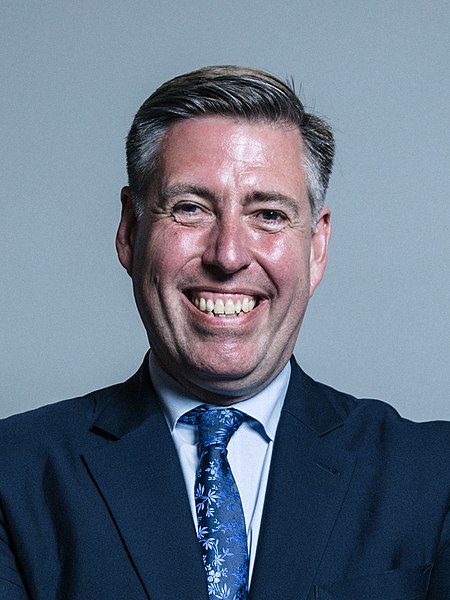
Graham Brady: The old-school MP who can bring the Tory Party back together – Matt Leigh

7 June 2019 | OPINION

I, like many other Conservatives, long for the days in which the Conservative Party had a set of values, an ideological mission. We were the party that once wished to revolutionise, to reshape the landscape of Britain. Whether that was Disraeli in his social vision of the ‘One Nation’ unified in reform and patriotism, or Thatcher in her reversal of Britain’s managed decline, the Conservative Party throughout its history as the most electorally successful political party, has always had concrete values: that of freedom, prosperity and patriotism – and we, the modern-day party, require an urgent history lesson of how not only to win elections, but how to efficiently nurture these values, before it is too late.

Just as the party chose to revitalise these values with the election of Margaret Thatcher as leader in 1975, we today as Conservatives find ourselves at a crossroads. We can choose to continue our pandering to ‘Blair-lite’ social democracy, or find ourselves renewed with a dose of traditional conservatism by electing Sir Graham Brady as the Conservative Party leader. At a time when we are faced with growing socialist values, we must fight to combat them with the ideals of conservatism. Fire must fight fire, and we as Conservatives should be sound in the knowledge that our values have a track record in winning the fight, and therefore we can rest assured that, one day, we can return this country to stability.

One such Conservative who is not shy of old-school conservatism is, after all Sir Graham. The outgoing Chairman of the 1922 Committee can be seen to unify the Parliamentary party, rallying the activists and members at various events. Yet, his ace of spades is inevitably his commitment to see through and champion the traditional values of conservatism.

If we elect a careerist parliamentarian, one so out of tune with the needs of Britain, out of tune with the values of conservatism that inspire fellow party members to knock on doors and deliver leaflets through the temperament of our fine British weather and political turmoil, we will cease to be a political force, resigned to opposition for a generation. But, if we have the courage and the conviction to elect a true conservative, someone with convictions that we hold to be good – a man who sacrificed his ministerial career on the basis of the educational values he holds dear – then we can be re-energised.

Graham has values. A longstanding eurosceptic, committed to our departure from the European Union, an advocate against the ‘backstop’. A committed and resilient figure within the debate to retain the choice of selective education, which allows talented individuals from lower-income households to compete against the privileged few. Brady himself is the epitome of a meritocracy – he is the ‘boy who done good’, attending a Grammar School, attending university – becoming the youngest Conservative Member of Parliament at the point of his election in 1997.

We need a vision of hope and of tradition, and we require his skills of unification, negotiation and litigation to unite the Conservative Party behind a vision and pursuit not only of Brexit but of a continued period of Conservative governance. Will it be easy? No. But the first steps, the baby steps, are finding the courage within ourselves as members, Parliamentarians and the wider Conservative Party to stand up and be counted. To own our values, and to champion them. To sell our message that, throughout history, has been refined but not changed. We need a traditional Tory, a traditional campaign and a solid, proven message. Graham has that message – he has continually championed it – and as such deserves our support to become the next leader of the Conservative and Unionist Party.

We cannot merely rely on empty statements, slogans or gestures. We need steadfast commitment. Commitment to Tory Democracy, Law and Order, Freedom and Patriotism. For without that, we may as well merge into the creeping, yellow shade of the Liberal Democrats.

More from this author

Don't miss...

Wolves of Westminster