



Home Blog Page 70

Boris Johnson to appear in court, Alastair Campbell expelled from Labour

29 May 2019 | UK NEWS

The political campaigner Marcus Bell has crowd-funded £200,000 to launch legal proceedings against Conservative MP Boris Johnson, who stands accused of misconduct in public office in relation to claims he made during the EU referendum campaign on behalf of Vote Leave.

Specifically, Mr Bell takes issue with Mr Johnson’s prominent claim that the UK sends £350 million per week to the European Union, saying that this claim has been disputed to the extent that it is arguable in law that Mr Johnson wilfully misled the British public. Mr Johnson’s lawyers have responded by claiming that these legal proceedings are “a stunt” whose sole aim is to damage the Leave cause and contribute towards reversing the 2016 referendum decision.

Mr Johnson faces three allegations of the offence, covering both the referendum campaigning period and the 2017 General Election. The case could potentially be a landmark in establishing the extent to which comments and standpoints made during political debate are viewed as a matter of law in the United Kingdom.

Ruling that there was sufficient evidence to proceed with a trial, District Judge Margot Coleman said: “The applicant’s case is there is ample evidence that the proposed defendant knew that the statements were false. I accept that the public offices held by Mr Johnson provide status, but with that status comes influence and authority.”

However, fellow Conservative MP and prominent Leave campaigner Jacob Rees-Mogg said: “It is a grave error to try and use legal process to settle political questions. The issue at hand is whether it was right to use the gross or net level of our contribution to the European Union – that is a matter of free speech and the democratic process.”

The political commentary blog Guido Fawkes carried a story today suggesting that Mr Bell has been previously associated with groups whose goal is to stop Brexit, in contrast to his claims that these legal proceedings are intended solely to address the issue of elected officials misleading the public.

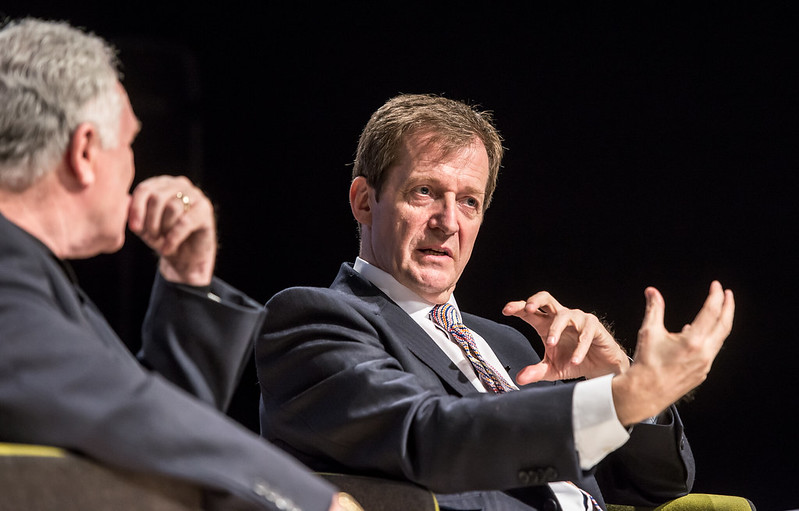
Meanwhile, former Labour spin doctor Alastair Campbell has been expelled from the party after he publicly admitted to voting for the Liberal Democrats in last Thursday’s European Parliament elections. Dawn Butler MP, the Shadow Minister for Women and Equalities, said that members who openly admitted to voting for other parties were “automatically excluded”. She added: “It’s just part of the rulebook. Everyone knows that.”

Mr Campbell responded by telling reporters: “I think it’s a strange thing to do, and I think people will inevitably draw the contrast between the lack of rapidity in dealing with cases involving anti-Semitism.”

It comes as the Equality and Human Rights Commission announced this week that it has launched a formal investigation into the Labour Party concerning allegations of anti-Semitism.

Elsewhere in UK political news, The Guardian reports that the Speaker of the House, John Bercow MP, has said he has no plans to stand down from his role in the near future, in contrast to a previous timetable he had set out for his tenure.

The Express also carried an interview with Lord Adonis (Labour) today, in which he stated that the one Conservative leadership candidate he saw as posing an electoral problem for the Labour Party was Rory Stewart MP.

Euro elections analysis: No mandate for a ‘no deal’ or second referendum – Chris Bradford

28 May 2019 | ANALYSIS

The parties with the clearest messages prospered in the 2019 European Union parliamentary elections as support for the mainstream parties haemorrhaged. Constructive ambiguity proved detrimental for Labour whereas the Conservative Party was punished for failing to deliver Brexit on March 29th. Nigel Farage’s newly formed Brexit Party attained 31.6 per cent of the vote, surpassing UKIP’s historic achievement in 2014, and the anti-Brexit, Liberal Democrats polled in second. Their simplistic and effective message was rewarded, particularly in London, where they polled ahead of Labour in the region.

One should remain cautious about overstating the impact of these elections. The main message that should be taken away is that the country remains heavily divided. It is too simplistic to interpret the outcome of the elections as a mandate for a particular type of Brexit or a demand for a second referendum.

Unlike general elections, EU parliamentary elections are second-order contests. This means that less is at stake; the incumbent national government is not removed from office if they experience a difficult night at the polls. As was the case in France, European elections can be framed into a mid-term or a referendum on the national government.

An element of protest was clear behind the voting behaviour in these elections. Compared to 2014, both the Labour and Conservative Party experienced a decline of approximately 11 per cent and 15 per cent respectively. With Brexit dominating the political discourse, the alienation of both parties was synonymous with their failings in trying to resolve the European question. The Liberal Democrats benefitted greatest from Labour’s ambiguous stance whereas the Brexit Party primarily exploited the failings of the Conservative government. 64 per cent of Leavers and 53 per cent of 2017 Conservative voters voted for the Brexit Party. The occurrence of these elections symbolised the government’s failure in negotiating Brexit.

Turnout also corresponds with the level of political apathy. Nationally, turnout was 37 per cent, marginally higher than in 2014. A surge was evident in Remain council areas, notably in Wandsworth, where turnout increased by over ten per cent. Turnout in Bristol and Monmouthshire increased by approximately seven and nine per cent respectively. Enthusiasm in Leave councils was muted and even transformed into apathy. Turnout in Sunderland, Wigan, South Derbyshire, for instance, remained static, whereas, staunchly Eurosceptic areas such as Rochdale, Basildon, Great Yarmouth and Thurrock experienced a decline compared to 2014.

Contrastingly to general elections, European Union citizens were eligible to vote which may be an explanation behind increases in turnout in Remain locations. However, apathy can be explained through disengagement and disillusionment caused by Brexit as the process has proven to be far more complicated than advertised in 2016. Or, the decline in turnout in the aforementioned council areas could be perceived as a boycott as the elections are a symbol of the UK’s failure to withdraw from the EU.  

Labour leader, Jeremy Corbyn, considered the elections to be a proxy referendum on the European issue. The elections were operating within the political uncertainty of failing to deliver Brexit, so naturally, the issue could not be separated from these elections. However, despite the clear positions on EU withdrawal advocated by the Lib Dems and Brexit Party, it is reductionist to argue that the elections were a form of a plebiscite on the European question. The Greens received 12 per cent of the vote, yet the party’s approach towards environmental issues, as opposed to Brexit, was the primary driver in influencing voting behaviour. Whilst not disputing the effectiveness of their anti-Brexit strategy, the SNP’s competence vis-à-vis other parties was credited as the salient motive. Brexit was a secondary issue for Conservative and Labour voters who premised their vote on tribal loyalties.

Political spin is used to manipulate election results into a convenient narrative. It is misleading to create such a narrative using Sunday’s election results. Remain sympathisers have added up the percentage of the vote achieved by pro-EU parties and have concluded it is a sign that public opinion has changed, simply because the collective total vote of the Lib Dems, Change UK, SNP, Greens and Plaid Cymru outnumbers the 34.9% who voted for Brexit Party and UKIP. Despite pursuing a course of action to leave the EU, the Conservatives are not included. With the Conservative Party included, the Leave vote share would be 44 per cent, whereas Remain would trail on 40.4 per cent.

Tory leadership candidate, Rory Stewart, announced that he would not countenance the prospect of a ‘no deal’ Brexit, describing it as damaging and unnecessary. In the event of a Eurosceptic Tory being elected then the party would countenance leaving the EU without a formal arrangement. This is an electoral strategy, designed to mitigate the potential impact of the Brexit Party on the Conservatives’ electoral fortunes. David Cameron, to a large extent, embraced the prospect of a referendum in order to  ‘shoot the UKIP fox’.

Due to the low turnout, the elections did not produce a mandate for a ‘no deal’ Brexit, despite Farage topping the polls. The party received in excess of 5 million votes, which translated into one in eleven voting for the party when the entire electorate is considered. Also, 76% of Brexit Party voters believed the party had the best policy on Brexit, but 84% supported Farage in order to express dissatisfaction of the Conservative government’s handling of Brexit. It is evident that the country remains bitterly divided on the issue of Europe. Both the Remain and ‘no deal’ positions have become entrenched to the extent that it has become a form of attrition warfare. Whilst not a second referendum in its own right, the consequences of these elections look set to form the foundations of a public vote with both parties veering towards the extremities.

Esther McVey: The Conservatives’ Champion of Social Mobility – Paul Maginnis

The Conservative Party is at a crossroads. After 3 years of parliamentary paralysis and stagnation in domestic policy, we need a leader who can once again show that the Conservatives are the party of social mobility. To use that well-worn phrase, we need a ‘new type’ of Conservative.

How about a Conservative who spent her early years in the care system so has real empathy for those from the most difficult backgrounds? How about a Conservative who has written several careers books and set up a charity to inspire young girls to achieve their potential? How about a Conservative who instead of relying on think tanks in London, has founded a bottom-up campaign seeking to attract working-class support? That Conservative is, of course, Esther McVey.

Esther spent the first part of her life as a Barnardo’s child in care and has spoken movingly about this in the past year. She still follows Barnardo’s work closely and I know she fully understands the crisis of aspiration we have for our young people in the care system. This is of particular importance to me, as I work across 20 children’s homes in the East Midlands, managing the young people’s education. Every day I see the disaster of family breakdown, children being moved 100 miles away from where they live and schools struggling to cope with behaviours. Having spoken to Esther McVey about this very topic, I know these challenges would be high on her list of priorities. 

Something which not many people know about Esther, is that she has written an inspirational careers book which aims to demonstrate that women can achieve their goals in any field. Esther also set up a charity for young girls, If Chloe Can, which works with secondary schools across the country.  Students are offered career planning, workshops and the aim is to develop young women’s aspirations, enthusing them to reach their full potential. As somebody who delivers careers workshops to looked after children, this is another huge area which is lacking and needs to be prioritised from the very top of government.

Esther is the type of Conservative who genuinely cares about speaking to the whole country, not just London and the South East. That is why the launch of Blue Collar Conservatism has been so refreshing. The group have been travelling all over the country, engaging with people’s ideas on how we can develop a policy platform attractive to the Midlands and the North. Many videos have been uploaded from normal grassroots members, with many different accents, discussing everything from why they are Conservatives to proposing policy questions for the future.

As well as a positive platform, we also need a leader with resilience. Let us not forget the disgusting abuse Esther has endured from McDonnell and Co, which she has dealt with in a calm and measured manner. But we must remember why they hate her so much. She is a working class northerner and has the audacity to be a Conservative. Labour think they ‘own’ people like Esther. They know, that under the leadership of somebody like her, the Labour heartlands of the North of England will be much more receptive to the Conservative message. 

We need a leader who will lead us into the future and crucially, take us to a time beyond Brexit – deal or no deal. A leader who doesn’t just care about image but has genuine policy proposals which have been developed through real life experiences. We need a leader who doesn’t run away from the debate with Labour, but take them on with conservative principles and pro-capitalist policies. That leader is Esther McVey.

Live: Euro election results – Brexit Party surge in UK

26 May 2019 | UK NEWS (BREAKING)

Initial results are rolling in on this historic European Parliament election night for the UK. These elections were never envisaged in the UK as recently as two months ago, but are already looking to produce hitherto unheard of results.

ELECTION TAKEAWAYS:
– Brexit Party leader Nigel wins seat in South East
– UKIP Leader and only MEP Gerard Batten loses (London) seat
– Former Conservative minister Ann Widdecombe has won a seat
– Brexit Party are sweeping the floor in the EU elections


We will be covering live result updates here.

22:12 – Leeds is first to declare, with the Brexit Party coming out on top, followed by Labour and the Liberal Democrats.

22:15 – Another win for the Brexit Party in Sunderland, followed again by Labour and the Liberal Democrats.

22:17 – BP on top, followed by Lib Dems and Greens.

22:20 – Labour come first in Ealing, followed by Lib Dems and BP.

22:22 – BP first in Sheffield, followed by Greens and Lib Dems.

22:23 – BP comes out ahead in Hillingdon, followed by Labour and Lib Dems.

22:24 – BP wins the day in Somerset West & Taunton, with Lib Dems next in line, followed by Greens.

22:25 – Lib Dems ahead in Bath & North East Somerset, BP second, Greens third. In Derby, BP comes first, with Lib Dems second and Labour third.

22:28 – Lib Dems on top in Kingston upon Thames, with BP next in line, followed by the Greens.

22:31 – Lib Dems hold Gibraltar by a huge margin with 7,220 votes, with all other parties measures in 3 figures. BP second, Greens third.

22:33 – Lib Dems in the lead in Richmond, with BP coming second, followed by the Greens.

22:34 – Brexit Party wins in Fenland, followed by the Conservatives and then the Lib Dems.

22:35 – Labour out in front to hold Leicester, followed by BP and the Lib Dems.

22:37 – Labour tops the poll in Birmingham, with BP next and then the Lib Dems. In Epsom & Ewell, we see a BP victory, followed by the Lib Dems and the Conservatives.

22:42 – Turning to Wales…
Cardiff – 1: BP, 2: Lib Dems, 3: Plaid Cymru
Blaenau Gwent – 1: BP, 2: Labour, 3: Plaid Cymru
Pembrokeshire – 1: BP, 2: Plaid Cymru, 3: Lib Dems
Monmouthshire – 1: BP, 2: Lib Dems, 3: Conservatives
Ceredigion – 1: Plaid Cymru, 2: BP, 3: Lib Dems

22:43 – In Chiltern, a victory for BP, followed by the Greens and Change UK.

22:44 – BP ahead in Cotswold, followed by the Lib Dems and the Greens. In South Hams, we see the same picture.

22:48 – A Lib Dem victory in York, followed by BP and the Greens. In Northampton, the BP claimed victory, followed by the Conservatives and Labour.

22:49 – Lib Dems ahead in Cheltenham, followed by BP and the Greens.

22:50 – Coventry declares victory for BP, followed by Labour and the Lib Dems. In Tewkesbury, we see another BP victory, followed by the Lib Dems and the Greens.

22:54 – Islington sees the Lib Dems edging out Labour by 873 votes for first place.

22:55 – In Scotland, we see the SNP coming out in front in Dundee, followed by BP and Labour.

22:58 – Mid Devon sees a BP victory, followed by the Lib Dems and the Greens.

23:01 – BP out in front in Exeter, followed by the Greens and the Lib Dems.

23:03 – A Labour victory in Nottingham, with the BP second and the Lib Dems third.

23:04 – A BP victory in Stroud, with the Greens next, followed by the Lib Dems.

23:07 – Green Party ahead in Bristol, followed by the Lib Dems, then the BP.

23:15 – BP leads in Mendip, with the Lib Dems next, then the Greens.

23:29 – 2 BP candidates, 1 Plaid and one Labour elected in Wales

23:34 – West Midlands: 3 BP in West Midlands along with 1 Labour, 1 Green, 1 Lib Dem and 1 Conservative

23:45 – Yorkshire and Humber elect 3 BP, 1 Labour, 1 Lib Dems and 1 Green. Leavers of Britain founder Lucy Harris elected.

23:50 – Jacob Rees-Mogg’s sister and former Conservative Annunziata Rees-Mogg gains a seat in the East Midlands under BP

00:15 – Election round-up so far – Brexit Party: 21, Liberal Democrats: 10, Labour: 7, Green Party: 5, Conservatives: 2, Plaid Cymru: 1

00:18 – South East Region: NIGEL FARAGE ELECTED AS A BREXIT PARTY CANDIDATE

00:23 – “We voted to leave, we were supposed to do so on March 29th and we haven’t” – Farage

00:24 – “We want to be part of the negotiating team” – Farage

00.26 – ” If we don’t leave the EU on 31 October, tonight’s results will be repeated in a general election.” – Farage

00:30 – South East elect 4 BP, 3 Lib Dems, 1 Green, 1 Conservative and 1 Labour

00:31 – North West: 3 BP, 2 Labour, 2 Lib Dems, 1 Green. Conservatives lose their representation.

00:45 – Labour Party leader Jeremy Corbyn says “we need a general election or public vote”

James Bickerton talks new group: ‘Campaign Against Corbynism’

24 May 2019 | VIDEO

James Bickerton is a journalist for the Daily Express, as well as Political Editor of the online magazine The Backbencher and creator of the PoliticsSnaps YouTube channel. He is aiming to set up a new campaigning group to challenge what he perceives as a new and dangerous orthodoxy taking root on the left of UK politics. He attributes much of this to Jeremy Corbyn and the various movements associated with him, but seeks to work primarily with moderate left-wing figures and voices to challenge it.

PM resigns effective from 7th June

24 May 2019 | UK NEWS (BREAKING)

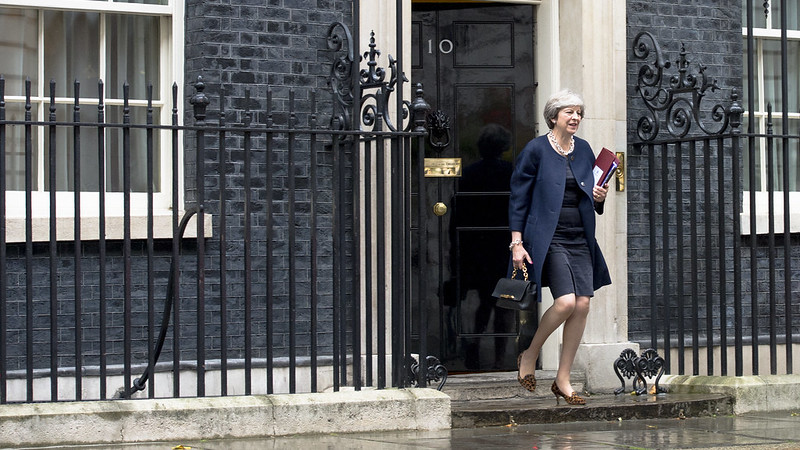
Theresa May has been meeting Graham Brady of the 1922 Committee this morning and is expected to announce her resignation immediately afterwards. This page will continue to be updated.

09.40 – Some movement through the door of Number 10, but no further news yet.

09.43 – Sound system being set up for PM speech, but no lectern yet. The BBC’s Norman Smith says PM will likely “dip below political horizon” and go back to her constituency after statement, while still nominally PM.

09.46 – In unrelated news, a Number 10 official has just emerged, picked up Larry the Cat and carried him back inside.

09.50 – The lectern has now emerged.

10.05 – The PM emerges.

10.07 – The PM confirms she will resign on Friday 7th June. The leadership contest to replace her will commence the week after.

10.11 – The PM concludes her speech in tears, saying “I will shortly leave the job that has been the honour of my life to hold. The second female PM, but certainly not the last. I do so with no ill-will, but with enormous and enduring gratitude to have had the opportunity to serve the country I love”. Cheers of support are heard inside Number 10 as she walks back through the door.

The best way to end the Brexit impasse – Chris Bradford

22 May 2019 | OPINION

Apologies Brenda from Bristol, but the country should go to the polls once again. Slowly but surely, a public vote is making logical sense. Parliament is in a logjam; the cross-party talks between the Government and Opposition are simply an exercise in ‘kicking the can’ down the road; not to mention, the widening disconnect between the electors and parliamentarians.

A recent report in the Sunday Telegraph suggested that the Prime Minister was contemplating a three-way referendum as a contingency plan in the event of the cross-party talks with Labour failing. In the article, it was reported that the options would be: Remain in the EU, leave on the Government’s terms, or leave without a withdrawal agreement.

Any three-way referendum would have to be contested under a transferable voting electoral system. Hypothetically, under first-past-the-post, Remain could poll 36%, No Deal could poll 33% and the Government’s Withdrawal Agreement could poll 31%.  Not only does the Leave vote get split under a majoritarian electoral system but despite 64% supporting Leave options in this scenario, the U.K. would remain in the EU.

The decision to leave was made in 2016. The question would permit the electorate to decide the UK’s future relationship with the EU. The options on the paper would include Labour’s vision of Brexit – either full membership of the single market, the customs union or present something that resembles their ambiguous concept of a ‘jobs first’ Brexit. The Government could use the Withdrawal Agreement which would form the essence of their pitch to the country, and Nigel Farage could champion the vision for a WTO Brexit.

This strategy allows the debate to be advanced. No longer, is it about the benefits or drawbacks about membership of the European Union. Like it or not, the answer was conclusive in 2016; 1.26 million is a considerable majority. Now, the debate should be about how we enact the referendum of 2016. Admittedly, Brexit is a broad narrative; it covers a wide spectrum of views. Post-Brexit, the UK could have a close economic relationship or we could diverge completely from the European project. A choice of this magnitude should be in the hands of the electorate.

Remain supporters should think carefully about the risk of a binary second referendum. I foreshadowed a binary choice between Remain and leaving without a deal. As we know from 2016, no referendum is a fait accompli. Remain may be the preferred outcome in this hypothetical scenario but imagine the fallout if a ‘no deal’ Brexit proved victorious. A disenfranchised and disillusioned electorate could quite easily denounce the socioeconomic and political risks that leaving without an agreement could result in as Project Fear. Disruption to just-in-time production chain supplies, food and medical shortages and the disintegration of the UK are only a selection of potential outcomes. One poll conducted by Panelbase for Sunday Times Scotland suggested that Scotland would vote 52-48 in favour of independence in the event of a no-deal Brexit.

Ultimately, the Brexit issue has gone beyond the issue of whether the country should remain in the EU. Referenda are dangerous; the traditional binary nature allows them to be manipulated into a narrative which is convenient.  It is not ridiculous to argue that a vote for ‘no deal’ in a referendum could be manipulated into a vote against the likes of Andrew Adonis, Anna Soubry, Chuka Ummuna, David Lammy and James O’Brien to name a few, who are at the forefront of reversing the 2016 result. A populist campaign echoing the narrative of ‘betrayal’, an ‘out of touch political class’ and ‘tell them again’ enriches the terrifying division of Westminster versus the people.

The problem with a binary choice is the issue of legitimacy. Remain voters would be alienated if the choice was the Government’s withdrawal agreement or to leave without a deal. Remain supporters would simply not engage, which would have an impact on turnout and a potential effect on the legitimacy of the vote. If the Government’s deal acquired 60-65 per cent of the vote on a turnout of less than 50 per cent, for instance, then a legal quagmire has been opened. Similarly, staunch Brexiteers would abstain if they felt they were being provided with a false choice.

This solution legitimises the argument that the UK should leave the political institutions but remain economically aligned to the Union, which would arguably be an accurate implementation of the June 2016 result. Remainers may be disheartened that the UK would be leaving but they needn’t be. In the event of soft Brexit option being victorious, there would be minimal change. All it takes is an energised campaign to articulate the benefits of retaining permanent membership of the economic institutions.

A classic smear is that the vote in 2016 was misinformed. ‘Informed consent’ is a moral argument adopted by those supporting a second referendum. Whilst claims on both sides were questionable, it is disingenuous to suggest 17.4 million were misinformed, purely on the basis that you are opposed to the result. A referendum on the future relationship would resolve the issue of ‘informed consent’.

The three options would be presented, allowing the electorate to make a rational choice once they have considered the benefits and drawbacks of the respective models. The toxic language of betrayal and division would be reduced significantly and that stems from not having Remain on the ballot paper of any second vote. A decision was taken and let’s have the adult conversation which will start the overdue process of bringing the country back together.

In discussion: the European Union

18 May 2019 | VIDEO

Wolves of Westminster journalists Patrick Timms and Ben Fisher discuss the European Union with Ben Aston from Lit News.

Brexit: The Outsider’s View – Ted Jeffery

22 May 2019 | OPINION

Whilst we sit around questioning our democracy and party allegiance, there doesn’t seem to be much thought spared for our European counterparts or how they see us. Do they think we are a cohort of single-minded “Rule Britannia” colonialists? Or are we just a bunch of bumbling Borises who make for a spot of light entertainment when the rest of the world isn’t busy worrying about Trump’s antics?

Felix Kehrel is a 20-year-old political activist from Germany, and he is associated with the youth wing of Angela Merkel’s party, the Christian Democratic Union of Germany. He spent most of his education as a student at the Scottish boarding school, Fettes College. Often nicknamed ‘the Eton of the North’, Fettes was Felix’s home for five years. It therefore only seemed natural that he and other international students at Fettes viewed Britain as their second home.

It was during his time at boarding school that the EU referendum took place. Kehrel says: “Even though the school was divided when it came to Brexit, everyone was under the impression the Remain side would win.” He goes on to mention that when he woke up on the morning of June 24th, he and other students felt “disheartened” – not by the UK as whole, but because of “young people failing to stand up for their future”.

A few years down the line, Felix believes that Europe can learn a great deal from what’s been happening, not just in the UK but in the US as well. When looking at the political significance of Donald Trump and Brexit, Felix feels that “reactionary politics” can teach us a lot about contemporary politics within Europe today. He says: “When it comes to elections, it’s not about the right or left any more, it’s much more about globalisation. It’s about Remainers who embrace globalisation and Leavers who fear it.”

Marion van Renterghem has just finished writing a book on nationalism and populism in Europe, having written about Brexit for Vanity Fair and The New European. She is a self-proclaimed “Brexit addict”. Morever, despite the rise of Eurosceptic parties such as the Alternative für Deutschland (AfD) and Marine Le Pen’s Ressemblement National, Marion doesn’t believe the appetite for a ‘Frexit’ or ‘Deutschleave’ is still there. She talks about the “Brexit chaos” and the “pure madness” being the sole reason for parties in France, Germany and Italy being put off the idea of leaving the European Union.

Like many Europeans, Marion feels as though Britain has made a mistake, and that although she’d ideally like to see it reversed, she believes there is no way back at this stage. Marion may have good relations with the likes of ‘People’s Vote’ champion Alistair Campbell; however, she is keen to point out that a ‘second referendum’ at this point would only end up with the Brexit side winning again.

Also, as a well-respected French journalist, Marion has held meetings with both the French President, Emmanuel Macron, and the Chancellor of Germany, Angela Merkel. She says: “Both leaders are frankly fed up with Brexit, and Macron especially would not like to see a second vote.” For Marion, it’s a straightforward case of ‘let’s see what happens’, and hopefully Britain can return to the EU once a new, younger generation gets into government.

Italy is a country that knows all too well about populist quakes. Ever since Luigi Di Maio and the ‘Five Star Movement’ found their way into a coalition, Italian politics hasn’t stopped bringing up the subject of ‘Italexit’.

Antonello Guerrera is the London Correspondent for Italian newspaper La Repubblica. He’s talked candidly about the difficulties of trying to comprehend the “endless riddles of Brexit” for an Italian audience. He says: “You have to be extremely precise when reporting on it; however, it is the most exciting thing to witness from a journalistic point of view.” Unlike Marion and Felix, Antonello doesn’t have a passionate view about whether or not the UK should stay within Europe. However, he says: “I’ve never seen such a political mess in my whole life.” He only views Brexit from a journalist’s point of view, rather than through the eyes of a citizen.

Despite the different degrees of passion over Britain’s departure, the one topic that brings the three together is that of tribalism and the notion of Brexit – and even Donald Trump in America – being the root cause for the rise of populism throughout Europe. On the other hand, it seems that in spite of all the uncertainty the UK might be experiencing, according to Antonello, most Europeans find the whole situation extremely amusing.

More from this author

Don't miss...

Wolves of Westminster