



Home Blog Page 71

PM to offer MPs vote on second Brexit referendum

21 May 2019 | UK NEWS

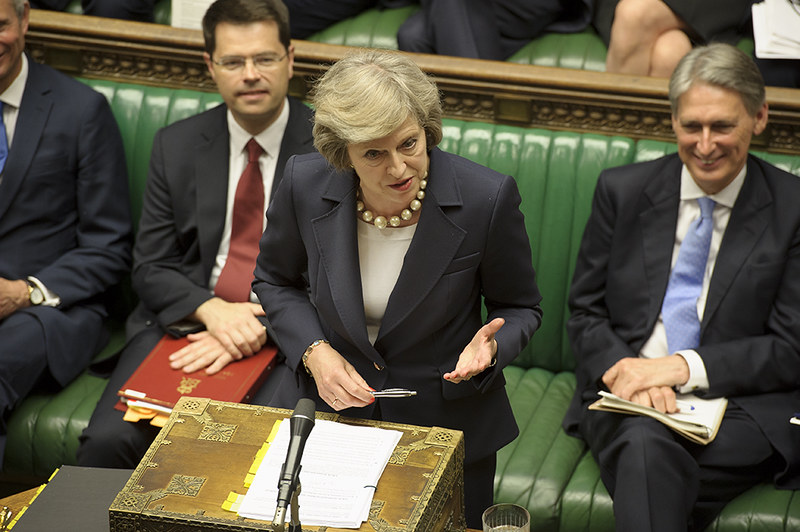
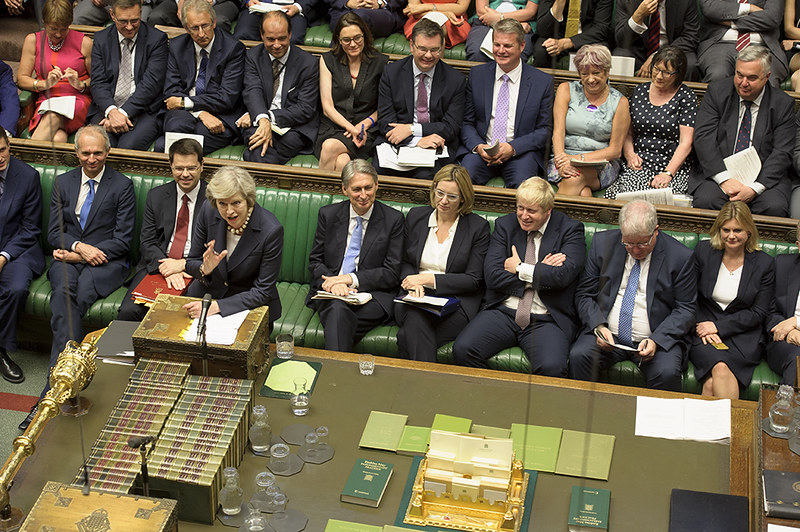
The Prime Minister has today announced her latest – and presumably final – attempt to ask to Commons to ratify her Withdrawal Agreement in Parliament. The most sensational element of her statement was her commitment to offering MPs the chance to vote on holding a second – or ‘confirmatory’ – referendum, but only if they vote the WA through first.

This would appear to be the end result of the Government’s cross-party talks with Labour, within which many powerful voices had been calling for any deal to be put to the people in a referendum. The compromise that has been struck is seemingly that the Government is only willing to allow MPs a vote – presumably, a free vote? – on whether or not to do this.

The Prime Minister stated that today’s proposals would constitute a “new deal” to be put to the House, differing in substance from the previous offerings that it has voted down three times since the start of the year. She has also promised the 1922 Committee that she will set out a timetable for her departure in the aftermath of this final vote, regardless of the outcome.

The proposals outlined by Theresa May today include seeking frictionless trade insofar as possible, by maintaining EU rules and standards on goods and agri-food products to avoid or minimise border checks. A new bill is also to be introduced to make it a matter of law that workers’ rights will be no less protected in Britain than they are in the EU. Nor are there to be any changes to environmental standards.

In terms of trade, the Prime Minister is proposing to offer MPs a choice between the Government’s current customs proposals as outlined in the Withdrawal Agreement, or Labour’s compromise proposal that involves a temporary customs union in goods alone. This proposal also stipulates that the UK should have some input in EU decision-making on this in relevant areas, along with an understanding that these arrangements could be altered in the future. Exactly how this would work or how the EU would respond to such a proposal remains unclear, although changes to the Political Declaration would be sought to embed this.

Furthermore, MPs would need to approve the negotiation objectives for our future relationship with the European Union, while the Government would also be legally obliged to find alternative arrangements to the backstop by the end of 2020. A final commitment is that Great Britain and Northern Ireland must remain aligned in the event of the backstop coming into force regardless, which would effectively create a single customs territory between the whole of the UK and the EU.

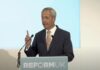
It comes as the fledgling Brexit Party holds its final rally before the European elections this evening, this time in London. Its leader, Nigel Farage, has decided to prosecute the man who threw a milkshake over him this week. The Express reports that he has complained of “double standards” on the part of the public in respect of himself versus other politicians.

Meanwhile, The Independent carries a story today reporting that some EU citizens in the UK are worried about being turned away from polling booths on Thursday, owing to an additional form they are required to fill in as foreign nationals.
Cabinet divisions intensify over May and Brexit – McVey

20 May 2019 | UK NEWS

As the Conservative Party prepares to fire the starting gun on its next leadership contest, ahead of the European elections this Thursday, a former Cabinet Minister has revealed increasing tensions at the top of Government as to how Brexit should be delivered.

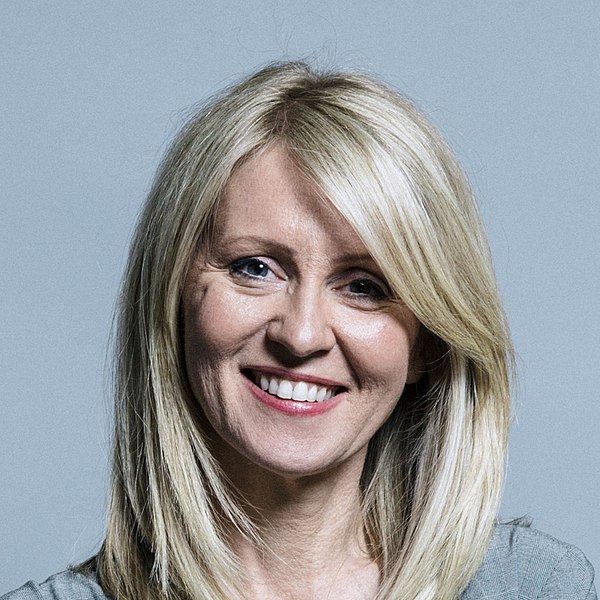
Esther McVey, the Conservative MP for Tatton and former Work and Pensions Secretary in 2018, told the Press Association that some of her former Cabinet colleagues were attempting to “dismantle” Brexit. The comments were made as she revealed more about her own campaign to succeed Theresa May as Prime Minister.

She may have been alluding to the One Nation group of MPs, including the current Work and Pensions Secretary Amber Rudd and former Cabinet Ministers Damian Green and Nicky Morgan, which is aiming to set out a vision for a more centrist Tory Party and is meeting in Parliament today.

Ms McVey said that “they are wanting things to stay in place so they can dismantle Brexit and get Remain through a back door”. Speaking of her own position on the topic, she urged an end to any further “backsliding” on Brexit and insisted the UK must leave the EU by the end of October, even if this means without a deal. She also stated her belief that the next Tory leader must be someone who “believes in Brexit” and “delivers on our manifesto”.

In other Government news, both the Foreign Office and the Department for Business, Energy and Industrial Strategy are set to face disruption this week as some of its staff, among them cleaners and caterers, will stage a walk-out from tomorrow in a dispute over pay and conditions.

The union PCS (Public and Commercial Services) is leading the charge, with its members at the Foreign Office taking strike action for two days, while workers at BEIS will be away for the rest of the week. The union is concerned about the conduct of Interserve at the Foreign Office, which it accuses of making “repeated blunders” in relation to pay. Its members are also angry that ISS and Aramark have refused to pay them at least the London Living Wage.

John McDonnell, the Shadow Chancellor, has called upon Greg Clark as the Minister for BEIS to intervene personally to resolve the dispute, saying it was “obvious that outsourcing has failed”.

In other political news today, The Telegraph carries a report that the left-wing campaigning organisation Momentum, which was founded to support Jeremy Corbyn as Leader of the Labour Party, is now attempting to convince him to adopt a four-day working week as official Labour policy. This is a policy once also championed by the Green Party.

In the wake of the recent speculation around whether the Brexit Party has been willing to accept foreign funding – although an investigation by Guido Fawkes has also revealed that the same can be said for the People’s Vote campaign – The Guardian reports today that the Electoral Commission will visit the Brexit Party’s offices tomorrow in relation to the claims.

What does Brexit mean? – Patrick Timms

20 May 2019 | OPINION

Why our use of language is very important

As a linguist, the way people use language has always been of great interest to me.  In a political sense, it reveals much about their intentions and their character.  It was once a topic of much consternation, for example, that when asked repeatedly to define what Brexit meant, the Prime Minister would only assert that “Brexit means Brexit”.

Hmmm – “not much to see here, move along”, perhaps.  How revealing that has come to be.

But certainly, it is a perfectly valid question to ask what leaving the European Union means, and the language that we use around this is important.  What, then, does it mean in clear and unambiguous terms?

It means that no EU institution, court or legislature can pass any law, ruling or judgment whatsoever that is in any way binding upon, or otherwise holds sway over, this United Kingdom ever again.

This is the bare minimum requirement for restoring “sovereignty” – i.e. full, national sovereignty.  We do of course continue to be bound by commitments we have agreed to as a party to plenty of other international treaties, but this is because we have chosen to be.  We are free to rescind these obligations at any time by withdrawing from those treaties, and that will not lead to political ruin or economic disaster.  This is not something that those proponents of the EU who claim that Britain is, in fact, still fully sovereign appear to understand.

Indeed, it is only in the EU where national sovereignty is at issue when it comes to international treaties and agreements.  It is only in the EU that “co-operation” means “integration”, “collaboration” means “subordination”, “unity” means “some people doing what others are telling them”, and “impossible” means “we’d rather not, thanks” (as with re-opening the Withdrawal Agreement, for example).  Nobody else behaves this way in the world, and this is why the EU is stagnating and fraying.  It is trying, and failing, to change the rules of the game.

So, what are the rules, and what is this game?

We have not thus far seen a return to the World Wars of the last century, and most likely we never will.  However, a good friend of mine from the Netherlands (with a Masters in International Relations) once told me that what far too few people seem to have grasped is that, as far as affairs on the world stage are concerned: it’s war!  This is not something that has ever changed.  Perhaps, in fairness, “war” is rather a strong term.  In truth, the reality is more like “competition”, and in this sense the various countries in our world are more like siblings or even families.

Throughout history, human beings have always lived in groups, and always will.  Nobody would question the reality, or indeed the morality, of individuals putting their families’ needs before those of others – and this, really, is all that national sovereignty is about.  It acknowledges the principle that there is no reason why anyone else, from anywhere else, is likely to place the interests of another country before those of their own – unless, of course, they make a genuine and principled choice to apply to change their citizenship and move there.

Another thing that the European Union likes to talk about a lot is “unity”, but in reality it does not truly understand this.  What, then, can unity be said to mean?

Unity means mutual collaboration, in the face of difference and diversity, through choice.

Without that choice, it becomes fairly meaningless, yet it is precisely by means of the removal of choice – or national sovereignty – that the EU seeks to “unify” its members.  With that in mind, the reason why it is not, has never been, and likely never will be as united as it claims becomes clear.  Take the Irish, for instance.  Two things were needed for the Republic of Ireland to recover its economy after the financial crash of 2008: in the first instance, a massive bailout from, amongst others, ourselves; in the second, a radical pro-business reform of their economy to slash the rates of things like corporation tax, attracting huge inward investment and job creation from major American behemoths such as Microsoft and Apple.

Only with the two in combination was Ireland able to survive, recover and even prosper – once again, highlighting the success of right-leaning economic policies on the world stage.  This, however, has come to anger certain other powerful interests and voices within the European Union, who have resented Ireland’s ability to out-compete them in this respect.  They are now moving, therefore, to remove the national veto from the arrangements for setting tax rates within the European Union, swapping this instead for the much-reviled Qualified Majority Voting mechanism – because, as mentioned earlier, on the world stage, it’s still war!

In doing so, they are taking away the right of the Irish government and its people to make their own choice as to how to run this aspect of their country.  Yet, how do they choose to describe this?  As a need for “greater unity”.  It is when we see their use of language for what it truly is that we come to understand why this European Union is failing – and thereby why it is imperative for Britain to extricate itself as soon as possible.

When we use language disingenuously in this manner, and in so doing, make a mockery of notions such as unity and sovereignty, we might fool many – but we will not pull the wool over the eyes of all.  The meteoric rise of the Brexit Party in European election polling over a period of scant weeks lays bare the fact that the scales have fallen from the eyes of the British public – and our siblings just across the water should be very, very afraid of what they have done.

Cross-party Brexit negotiations collapse

17 May 2019 | UK NEWS

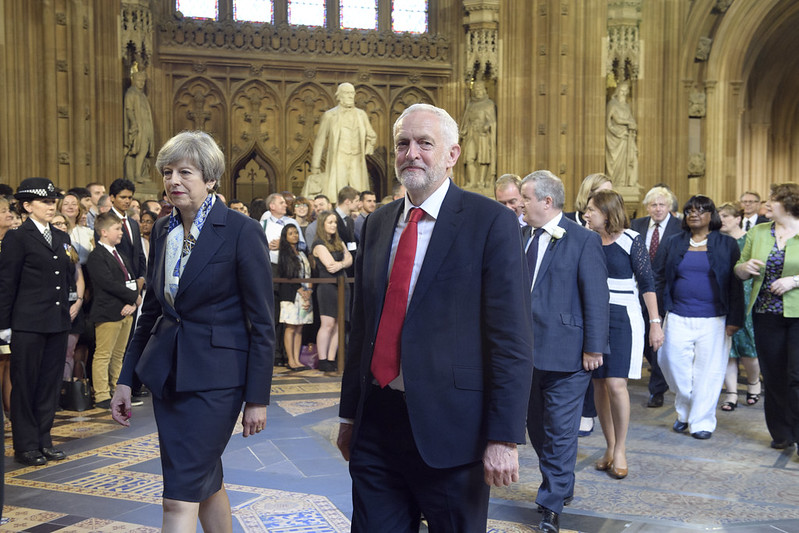
The cross-party talks between the Conservative Government and the Labour Opposition broke down today, with Jeremy Corbyn writing to the Prime Minister to say that these talks had “now gone as far as they can”.

Mr Corbyn’s letter explains that the “important policy gaps” still remain and appear insurmountable. While praising the overall process of the talks, on both sides, he further notes that he and his Shadow Cabinet do not have confidence in the Government’s ability to secure any commitments agreed to in these talks, referring to the “increasing weakness and instability” of Theresa May’s administration. He also makes reference in this context to what many now see as the Prime Minister’s inevitable resignation and the Conservative leadership contest to follow. The tone of his letter appears very much in line with that of a potential Prime Minister-in-waiting. Readers can view it here:

In also highlighting the notable contradictions between policy points put forward for negotiation and public statements by senior Ministers, however, it is worth bearing in mind that the same has been true in the Labour camp. Nonetheless, the cross-party compromise phase of the UK’s ‘internal’ Brexit negotiations is now over and has not produced a result.

According to Mrs May’s plan, she will now expect to outline a further process of indicative voting in the Commons, possibly in the form of a run-off, in order to find a way forward that is acceptable to Parliament. As ever with such proceedings, it is eminently possible that the end result will be one that nobody is happy with.

The news is likely to generate further consternation within the 1922 Committee, given that they had met yesterday and agreed to allow Mrs May another two weeks to get her Withdrawal Agreement ratified in Parliament. However, this was presumed to be contingent upon the cross-party talks yielding a workable compromise, given that there are no other foreseeable circumstances in which this could happen. Today’s news, then, calls the nature of this extension into question.

Nonetheless, the Prime Minister is expecting to bring forward a second reading of the Withdrawal Agreement Bill in the first week of June regardless – a week that also includes President Trump’s state visit, and the Peterborough by-election to replace Fiona Onasanya. By all accounts, that week will not be boring!

Elsewhere in UK political news, The Telegraph has published a three-part documentary called The Disk, in which it chronicles its investigation of the MPs’ expenses scandal that broke 10 years ago this month. This notably marks the last time that trust in elected politicians was shattered, prior to the high drama around Britain’s departure from the EU.

The Mirror has also revealed “online loopholes” in the Brexit Party’s registered supporter scheme, by which they mean that anyone – including non-UK residents using non-UK credit or debit cards – can register and thereby send money to the Party. They add that MPs will now launch an investigation into this, following their revelations.

Former Justice Secretary under re-nationalisation pressure

16 May 2019 | UK NEWS

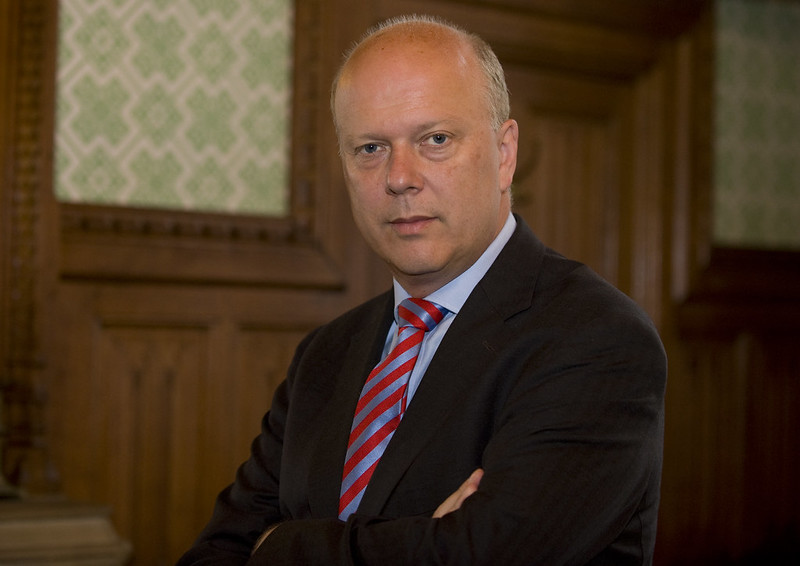
We read this morning that the Transport Secretary, Chris Grayling (right), is under renewed pressure owing to the decision to re-nationalise the offender supervision service. Grayling had taken the decision to part-privatise it while Justice Secretary in 2014, but this is now being reversed.

The privatised elements of the service had come in for heavy criticism, with chief probation inspector Dame Glenys Stacey saying today that she was “delighted” with the decision to re-nationalise and the current Justice Secretary, David Gauke, acknowledging that “the system isn’t working”.

It comes amid Press Association coverage of other criticism directed at Mr Grayling in his time as a Cabinet Minister. Of particular note is the “Brexit ferries” scandal, when Grayling awarded a £13.8 million contract to Seaborne Freight to carry extra cargo in the event of a No Deal Brexit, until it emerged that this firm did not presently own any vessels. There was then a further blow for the Department of Transport when it was forced to settle out of court for £33 million with Eurotunnel, following their claims that the process for awarding contracts had been “rushed” and that they had been passed over.

Mr Grayling has also faced criticism over his handling of changes to train timetables for Northern Rail and Govia Thameslink, leading to hundreds of train cancellations per day and weeks of chaos. The DfT was further named by the National Audit Office for making decisions that “negatively impacted on passengers” during the long-running dispute between Southern Rail and trade unions over driver-only trains, leading to the latter’s prolonged strike action.

Another controversy was Mr Grayling’s decision, while Justice Secretary, to ban prisoners from receiving books from friends or family while serving their sentences, in a move that was branded “cruel” by prison reform campaigners for fear that it would further impact upon offenders’ mental health. This succession of perceived blunders has earned the Transport Secretary the nickname of ‘failing Grayling’.

Elsewhere in re-nationalisation news, the Labour Party has today unveiled its plans to bring the National Grid into public ownership should it win power in a General Election. The Party says that its National Energy Agency would accelerate the drive towards greener national power provision, while the National Grid itself has suggested the opposite.

Calling the plans the “last thing” that was needed, the National Grid responded that they would “delay the huge amount of progress and investment that is already helping to make this country a leader in the move to green energy”.

Labour’s plans also include outfitting almost two million homes with solar panels, including social housing and the homes of those on a low income, to reduce their fuel bills while sending any unused electricity back to the National Grid, which would itself be nationalised. The Party is further planning to make grants and loans available to the public to encourage uptake, while adjusting the regulatory landscape to accommodate the changes. These plans form part of the Party’s goal of a “Green Industrial Revolution”, which spans housing, transport and industry.

In the newspapers today, we read in the Express that new polling in Scotland puts the Brexit Party in second place, creating a potentially worrying situation for the governing SNP and calling leader Nicola Sturgeon’s claim that Scots are generally opposed to Brexit into question.

The Independent also carries a story today that Theresa May’s former chief adviser has told her that “the game is up”, and that it is now her civic duty to stand aside to prevent further “national humiliation” over Brexit.

UPDATE at 2pm: Boris Johnson has confirmed his intention to run for Prime Minister when Theresa May resigns, telling the BBC “of course I’m going to go for it”.

UPDATE at 4pm: The 1922 Committee has reportedly given Theresa May another two weeks to try to ensure Britain’s orderly departure from the European Union before setting out her timetable for resignation. They had previously been expected to demand that she do so today.

May embattled at PMQs

15 May 2019 | UK NEWS

Following a convivial early atmosphere across the House, it was the Prime Minister herself who launched the first attack in today’s PMQs. The Leader of the Opposition appeared almost Prime Ministerial as he deflected this, moving the discussion on to the ideological back-and-forth between the Labour and Conservative benches that has been par for the course with this pairing of Government and Opposition leaders.

Theresa May once again defended the Conservative Government’s record on employment, job creation and wage inequality, although the impact of this on the wider economy did not come up. Jeremy Corbyn raised the issue of a food bank being opened at the Department for Business, Energy and Industrial Strategy on Victoria Street, in London, for some of its own staff. The Prime Minister chose not to address this particular issue directly.

Questions then returned to the floor of the House, with veteran Labour MP Barry Sheerman explaining how he had entered the House forty years ago as an ardent Eurosceptic, but that he was now a supporter of the EU as he had seen it “deliver prosperity” and “clean up the environment”. He urged the Prime Minister to “tell the truth” about the European project, to which she responded – as ever – that the public had already been asked this question and their vote was for us to depart.

Conversely, long-standing Conservative MP Peter Bone produced and quoted from a letter he had been sent by his local Conservative campaigners and activists in Wellingborough, demanding a No Deal exit from the European Union and calling on the Prime Minister to finally resign. As ever, the Prime Minister responded politely yet firmly, but without addressing their requests directly. Instead, she used it as yet another opportunity to castigate the House itself for failing to agree on workable options for leaving the EU.

The other issues raised today included how best to support and help identify young carers, given that this is Mental Health Awareness Week – indeed, Members’ green ribbons were widely on show. The Home Secretary also nodded along in agreement with one Member’s concern at the death of a constituent who had been shot with a crossbow on Good Friday, and there were indications from the Government benches that it would look to review the law on crossbow ownership.

In other UK political news, we read today in The Telegraph a piece by Conservative MP Crispin Blunt, who says that the Conservatives should prefer an electoral alliance with the Brexit Party over Labour. The Guardian is also reporting on the plans to be laid out by the Labour Party on Thursday to nationalise the UK’s energy network.

Tunbridge Wells backs No Deal – Tom Pritchard

17 March 2019 | UK NEWS

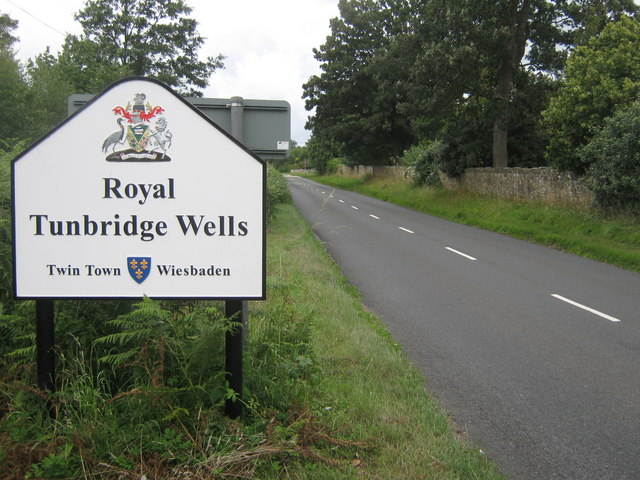
The National Conservative Convention recently passed a motion which supports leaving the European Union in 2019. On Friday 15th March, the Tunbridge Wells Conservative Association joined the growing list of Associations that support this.

I was at the scene for the debate. A large majority of members in Tunbridge Wells voted in favour of endorsing the motion. It was proposed by former MP for Colne Valley, Graham Riddick, who served in Parliament from 1987 until 1997. 

After the motion passed, Graham Riddick commented “we should get on with Brexit and do the job properly with no half-measures“. MP for Tunbridge Wells Greg Clark also commented; “I completely agree” and that the motion was “consistent with the party’s national convention”. 

Graham Riddick’s comments struck a more passionate tone. Mr. Riddick, who is also Chairman of the Trustees for the Tunbridge Wells Conservatives, is a vocal and enthusiastic supporter of Brexit. Some members voiced  frustrations with Greg Clark over his position. Despite this he remains very popular with local party members.

————————————————-

Tom Pritchard is Branch Secretary for the Tunbridge Wells Conservative Association. Follow him on Twitter @ClowesPritchard

Animal Co-operative – author Q&A with Robert Adam

14 April 2019 | ANALYSIS

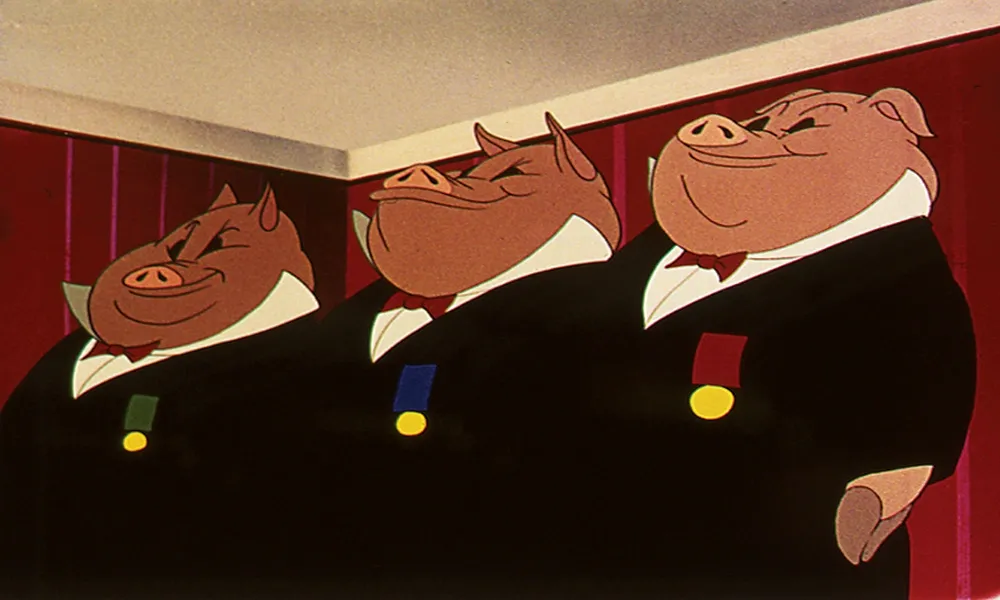
Animal Co-Operative is the story of the EEC and the EU, up to recent times, told in the allegorical style of Animal Farm. You can purchase it here

Written by author Robert Adam, it is a must read for those interested in political allegory. 

What drove you to write the book?

Ever since reading Animal Farm in English class at school I’ve had a fascination for the use of allegory to tell a story which can feel more ‘real’ than the events it purports to cover. I’ve always followed politics closely and consumed far more history books than I care to count – writing is simply a natural outgrowth of that.

What is the book (and why it isn’t a ‘Animal Farm’ sequel)?

‘Animal Co-operative’ is more parody than allegory – the potted history of the EEC & later the EU in a text slightly longer than Animal Farm itself. It’s not a sequel for Orwell’s book, because the story is different. He wanted to show the true nature of the Communist Party regime in the Soviet Union to its Western supporters (in my view, the actual ‘sheep’ of his story, parroting the lines given them by Moscow). 

Animal Co-operative instead tries to get across the technocratic nature of the EU and how it grew, click by click of the famous ratchet (the engrenageof Jean Monnet), and show the enfeeblement of the broken national democratic systems it left behind as the wheel turned. Having said that, coming back to Animal Farm, there is an argument that, after Stalin, the CPSU also formed a technocratic government – the technocracy in their case being that of Marxism-Leninism.

Isn’t it too late to write a parody of the EU’s development now?

After three years, it seems like the debate hasn’t moved on much – while the theme of restoring representative democracy seems, from the Lord Ashcroft polling, to have been the main driver of the vote to Leave, the fact that this won’t ever truly be on offer from the EU hasn’t got through to the other side. Even the Martin Selmayr scandal of 2018, where the Commission changed their own rules to allow him to grab the Secretary-Generalship has hardly registered. Thanks to the power of inertia, the EU will be around for a long while yet, no matter what the fiercest Eurosceptics say. It’s important for everyone to understand the nature of what we’re going to be carrying on living alongside. 

Why should I read the book?

If you want the actual history of the EU’s development over its first 50 years, then read ‘The Great Deception’, written by Christopher Booker and Richard North in 2005 and updated in 2016. The benefit of satire is that it allows compression of time, speeding up the flow of history, allowing Monnet and his successors’ plans to be seen from a different angle – all in a couple of hours’ reading. 

It can also be fun to decode the satirical depictions (although I’m still bugged by wanting to know who the ‘old ram … suffering from a cough’ was in Chapter 7 of Animal Farm). Without giving anything away, I had to find analogies for the European Coal & Steel Community, the European Defence Community, the Common Agricultural Policy, Exchange Rate Mechanism, Single Currency and five Treaties – among many others. I’m still waiting to see who from the book’s initial audience has spotted the reference to a suffragette story in the first chapter. The somewhat bizarre reality is that the story of the EU, and Britain’s relationship with it, lends itself almost too directly to satire – indeed a couple of the ‘marketing’ slogans the Community came up with at the time of Maastricht could be transcribed almost word for word, such was their ridiculousness.

Where can I get it?

Animal Co-operative is on Amazon, in Kindle edition and in paperback, through Amazon’s print-on-demand service. 

What else have you written?

A long while ago I fell in love with the Bernie Gunther series by Philip Kerr (sadly no longer with us). I’ve devoured everything by Robert Harris and been captivated by the writing of Forsyth. 

My offering in that broad genre of historical political fiction is called ‘At the Court of Charlemagne’ (also on Amazon) – it explores the technocratic origins of the EU, stretching back well before 1952, through the eyes of a fictional EEC internal investigator.

What’s next on your to do list?

History doesn’t stop happening, and I suspect that before long I’ll have to write an updated version of Animal Co-operative and create some new characters with which to tell the next chapter.

If you’d like to ask any questions about the book, or make suggestions, please contact me via my Goodreads.com Author Page

————————————————-

Robert Adam is an author and political commentator. 

Follow him on Twitter @RobertAdam1969

The Conservative Party: split incoming? – Reece Harris

9 April 2019 | ANALYSIS

In an alternative universe, May isn’t PM, a Brexiteer is in charge of the Brexit negotiations and we would not be in a political crisis.

If May wasn’t prime minister we would not be in our current situation. This is nothing personal against May, I for one think she would have been a brilliant “peace-time” PM, but in the current situation, when the government are in chaos, she is not the right person for the job.

Let me address something, people who talk about how May has a really hard job and we should have pity on her need to stop; she went into this situation with full knowledge of the job ahead. May could have left the job to a Brexiteer, like Boris or the more sensible Gove, and things could’ve gone a lot smoother. She had full knowledge of the role ahead and the most senior job in our country should be taken seriously. 

In my view, it went downhill for the Conservative Party when Cameron resigned. He was an amazing PM and should’ve stayed on. However, he was the frontman for Remain. We know how disastrous his pre-referendum negotiation with the EU was, in which he came away with next to nothing in reform or change of rules, especially on immigration. 

The resignation of Cameron, after the country voted Leave, started a leadership election in which May, the only Remainer in real contention, went against Boris, Gove and Leadsom. If Gove didn’t hadn’t gone against Boris, we very well could have seen a different outcome to the negotiations and we could be sitting here today an independent nation. Under Boris we could have had a deal that doesn’t keep part of the UK in a customs union, one that doesn’t make us a rule taker from the ECJ, and one that allows us to make our own trade deals. 

One of the Tories biggest mistakes was letting a Remainer be PM at such a crucial time, as even though May has been great on more domestic issues, she’s been a victim of the issue of the day.  

The May premiership started a whole host of problems. Most notably her deal/s, which divided the Tories. She should have resigned after she failed miserably, succumbing to the highest government defeat in Parliament’s history. Her biggest problem is that she is ‘too strong’. 

Her arrogance has split the Party at a level not seen since the Corn Laws and Catholic Emancipation in the Pitt to Peel era. The ironic thing is that the Party came out stronger from that, with Liberal Toryism, but I don’t think history will repeat. 

This will be a turning point for the Conservative party, and we are at a real danger of splitting.

————————————————-

Reece Harris is a political commentator and graphic designer. 

Follow him on Twitter @ReeceTheTory

May will throw Brexit and the Tories under a bus – Toby Amiel

12 May 2019 | OPINION

By end of this month, Theresa May will become Britain’s 13th longest serving Prime Minister. Despite breaking multiple promises about Brexit and losing over a thousand councillors in the local elections, she will still be our Prime Minister. 

According to recent reports, she is determined to secure ‘her legacy’ as PM and has promised to go if she gets her deal through Parliament. Once May’s premiership is seen through this lens all recent events become clearer. She has  refused to resign because to do so would see her go down in history as the PM who failed to deliver Brexit. By doing a deal with Labour and Jeremy Corbyn, whom for three years we have been told is a ‘threat’ to Britain, she hopes to secure the passing of her Withdrawal Agreement through Parliament. She hopes this will result in her avoiding the fate of the Prime Minister who bottled Brexit. In her increasing desperate ‘Brexit means Brexit’ at all costs, or in the case of the potential deal with Labour, Brexit means BRINO (Brexit In Name Only). So diluted is her position now from when she gave her Lancaster House speech in January 2017, that this is not too much of an exaggeration.

There has even been talk this week of her determination to stay in office for longer than the tenure of the much lamented Gordon Brown, and that in itself speaks volumes of her ambition. To put this into perspective, our most recent Prime Ministers all have tainted legacies to varying degrees. Tony Blair, often referred to as the ‘most hated man in Britain’ today will forever be remembered for, on the one hand achieving electability for the Labour Party years but most damningly taking Britain into Iraq. Similarly David Cameron won office for the Tories but will go down in history as the man who brought about Brexit. 

Politics, both inside and outside Westminster, continues to be dominated by Brexit. Other pressing issues facing our country are relegated to the side-lines. It is clear that Government policy has effectively been put on hold until Brexit is fulfilled. Under current Conservative Party rules leadership challenges can only occur once every 12 months and a lot of blame has, rightly, been attributed to the ERG for fatally mistiming their attempted coup. 

Nonetheless the 200 MPs who voted confidence in May in December must also be questioned. One has to wonder what they were thinking. The deal with the EU had already been done by that point and it was clear to all but the most deluded of Cabinet Ministers that it was about to receive a heavy defeat in the House of Commons. 

Of course the rules around a second leadership challenge in less than twelve months could be changed but the Tory party is heavily split with Brexiteers desperately wanting May gone but Remainers, of which there are a majority in the Conservative Parliamentary party, keeping her in position for fear of something worse. They are so terrified of a Boris Johnson or Dominic Rabb premiership that they are willing to stick with the current farcical situation.

For many Tories it is simply unthinkable to actually have a real Brexiteer in charge of Brexit. Far from the Brexiteers holding the party to ransom it now appears the Remainers are doing just that. 

So the Conservative party continues to suffer from a chronic lack of leadership. The lights are on, but no one is home. And this country continues to limp on.

More from this author

Don't miss...

Wolves of Westminster